
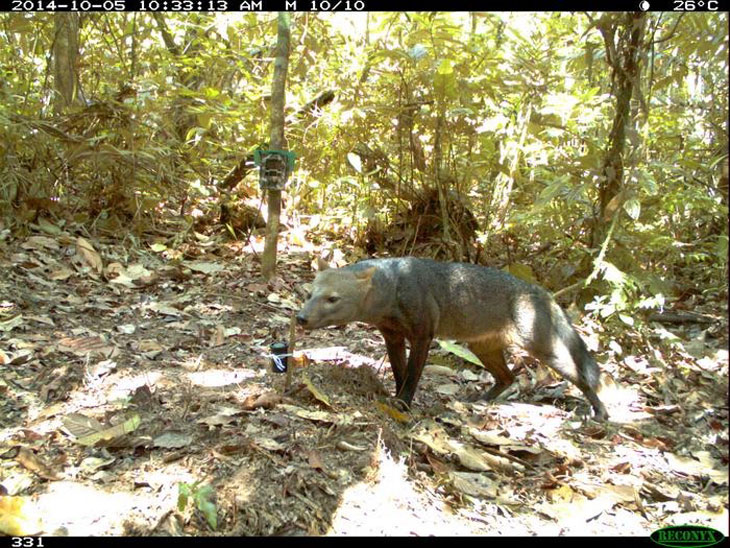
Thanks to a substantial network of camera traps, teams from the Wildlife Conservation Society have recently gained an unprecedented glimpse of a relatively discreet Amazonian canid: the “ghost dog”.
Atelocynus microtis
Launched more than a quarter of a century ago, this long-term study involved dozens of cameras scattered across the wild plains of Bolivia and Peru, notably the Grand Madidi-Tambopata and the Llanos de Moxos. In total, nearly 600 images of the short-eared bush dog (Atelocynus microtis) were captured. Other predators identified include jaguars and ocelots.
As explained by the authors of the new study, published in the journal Neotropical Biology and Conservation, until now our knowledge of this stocky canid has proven very limited: it rested on a handful of museum specimens and direct observations by seasoned biologists.
Recognizable, as its name suggests, by its short, rounded ears, A. microtis has a fairly heavy head, as well as a coat with reddish highlights and a fluffy tail. It is distinguished from other Amazonian canids by its semi-webbed paws. Notably observed in fishing cats, this adaptation suggests that it is a good swimmer, regularly moving through the waterways of the forested regions it occupies.
Images captured over the past decades indicate a mostly diurnal lifestyle, with a peak in activity between 6 a.m. and 12 p.m. According to the researchers, their relative absence at dawn and dusk suggests they would thus avoid competition with nocturnal predators.
An Unexpected Range
The species’ distribution range has surprised researchers as well. While they were thought to be extremely rare, these observations suggest a density of roughly 15 individuals per 100 square kilometers, higher than that of major Amazonian predators such as jaguars in some regions.
The lack of knowledge about the bush dog mainly stems from the wild and remote nature of its habitats. This does not, however, guarantee the species’ long-term persistence, as it is currently listed as Near Threatened by the International Union for Conservation of Nature.
“The protection of the Amazon rainforest canopy, through the establishment of protected areas, as well as the sustainable management of Indigenous territories, is essential today,” the researchers conclude.
The “ghost dog” of the Amazon belongs to the American subtribe Cerdocyonina, which includes wild canids such as the crab-eating fox (which is not technically a fox) and the maned wolf.

Contact details
Address:
Farmers Forum,
36, Dominick Street,
Mullingar,
Co. Westmeath,
Ireland
Phone:
+353 (0)44 9310206
Or email us:
For technical issues please check out our FAQ's page or email - [email protected]
For general Queries email - [email protected]
Request to add event to our Calendar - [email protected]
Send us your mart reports - [email protected]
Suggestions and feedbacks - [email protected]
News Items / Press Release - [email protected]
To Advertise on Farmers Forum - [email protected]