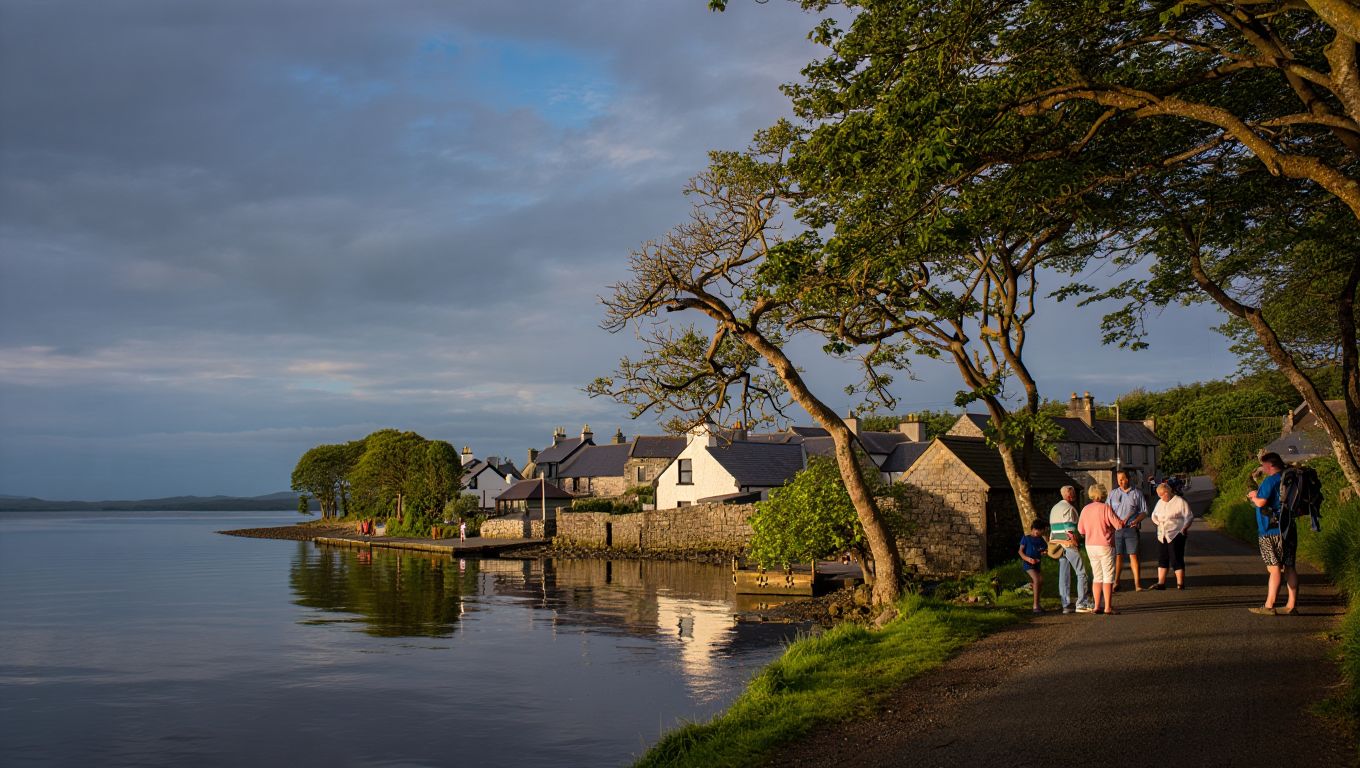
Mist drifts off the lake at first light, and the stone lanes of Cong start to glow. You hear a rooster, the soft slap of water on a wooden hull, and the day loosens its shoulders. The village sits at the northern fingertip of Lough Corrib, holding the in-between space where rivers slip through limestone and legends seem perfectly reasonable.
Where water writes the script
The shore is a storyteller, and Cong listens. On Lough Corrib, boats nose past reeds and into wide water that holds “one island for every day of the year.” Skippers repeat the number with a wink—365—before opening the throttle and letting the village exhale behind them.
“Out here, you breathe different,” says a local ghillie, eyes on the riffle where the mayfly lift each May and June. “It’s the hush that gets you, and the sudden splash when a trout remembers himself.”
Stones, arches, and a hint of cinema
In the village, ruined cloisters are stitched with moss, and arches hold shade even at midday. The abbey is a rehearsal space for sparrows, and the Monk’s Fishing House—squat on the river—is a patient geometry of ashlar and light. Film pilgrims still find the pub from The Quiet Man, peering at sepia stills before ordering something dark and creamy.
“People arrive with an old movie in their heads,” a bartender tells me, “and leave with a different film—their own.”
A castle’s long shadow
Across the water, Ashford Castle casts a storybook silhouette. You don’t need to check in to feel its orbit; falcons wheel above the woods, and narrow paths wander through giant trees to hush-dim clearings and streams stitched with light. On the pier, boats idle like patient horses, ropes fretting, diesel breath warm and faint.
Even near the castle, the village refuses stiffness. It’s playful—kids racing bikes, a dog proud of a stick much too long, couples puzzling over a map that keeps folding the wrong way.
On the water, everything slows
Lough Corrib is vast, but it greets you in small ways: a ripple’s code, a heron’s algebraic curve, a rainbow like a rumor over pine. Inchagoill Island, with its early-Christian stones, feels less like a site and more like a pause. Touch the Lugnaedon Pillar and the centuries press lightly, like a hand at your back.
Summer means boats, picnics, and the kind of weather that changes its mind every ten minutes. Locals call that Tuesday. Travelers call it drama, and the lake obliges with sky that rewrites itself on the hour.
Food, fire, and the last glass
By evening, grills get brave. Trout appears with butter that knows its job, bread arrives still thinking about the oven, and someone decides on oysters because that feels right. Pints settle like confident speakers, and conversation finds second wind.
I ask a visitor what they’ll remember. “The easy kindness,” she says. “A stranger told me the best turn for the woods, and I ended up among bluebells that sounded like rain.”
Ways to step inside the day
Not everything here asks for a ticket. Much waits at arm’s length: paths, stone, water, and a timetable that suits a meander more than a march. Try a day like this:
- Dawn by the abbey for soft light, mid-morning boat to Inchagoill, lazy lunch with the river, slow loop through Cong Woods, falconry on the edge of evening, and music where the pint rings true and the fiddle forgives.
When summer leans in
Between May and September, the village hums. Windows bloom with geraniums, and car roofs sparkle with the occasional squall. If you can, stay a night or two; the second morning feels less like travel and more like belonging. Early or late in the season, you’ll find space to linger, shadows longer on walls, and a rhythm you can carry home.
Traffic pauses for sheep with agendas, and nobody seems to mind. “They’re locals,” a driver laughs, rolling down the window. “We’re just visiting.”
Little rituals that matter
Bring a layer, even in sunshine—weather here moves like a curious cat. Step aside on narrow paths, wave to skippers guiding boats through the shallows, and let the day widen at its own pace. If you fish, hire a ghillie; the water is intricate, and the lessons travel well beyond the rod.
Most of all, listen for the quiet. It isn’t empty; it’s fully occupied by wind through birch, rope on ring, and laughter skipping off the water. That’s the village’s secret engine—old stones, big lake, and a summer that teaches your pulse to loosen and your gaze to go a little soft.

Your articles as some form of low rent Temu influencer are dreadful.
Are they AI generated?
In which case your AI is pure dumb
The Bray to Greystones cliff walk was a particular classic, since it’s been closed for 7 years.
Whoever is sponsoring this drivel, have a word.