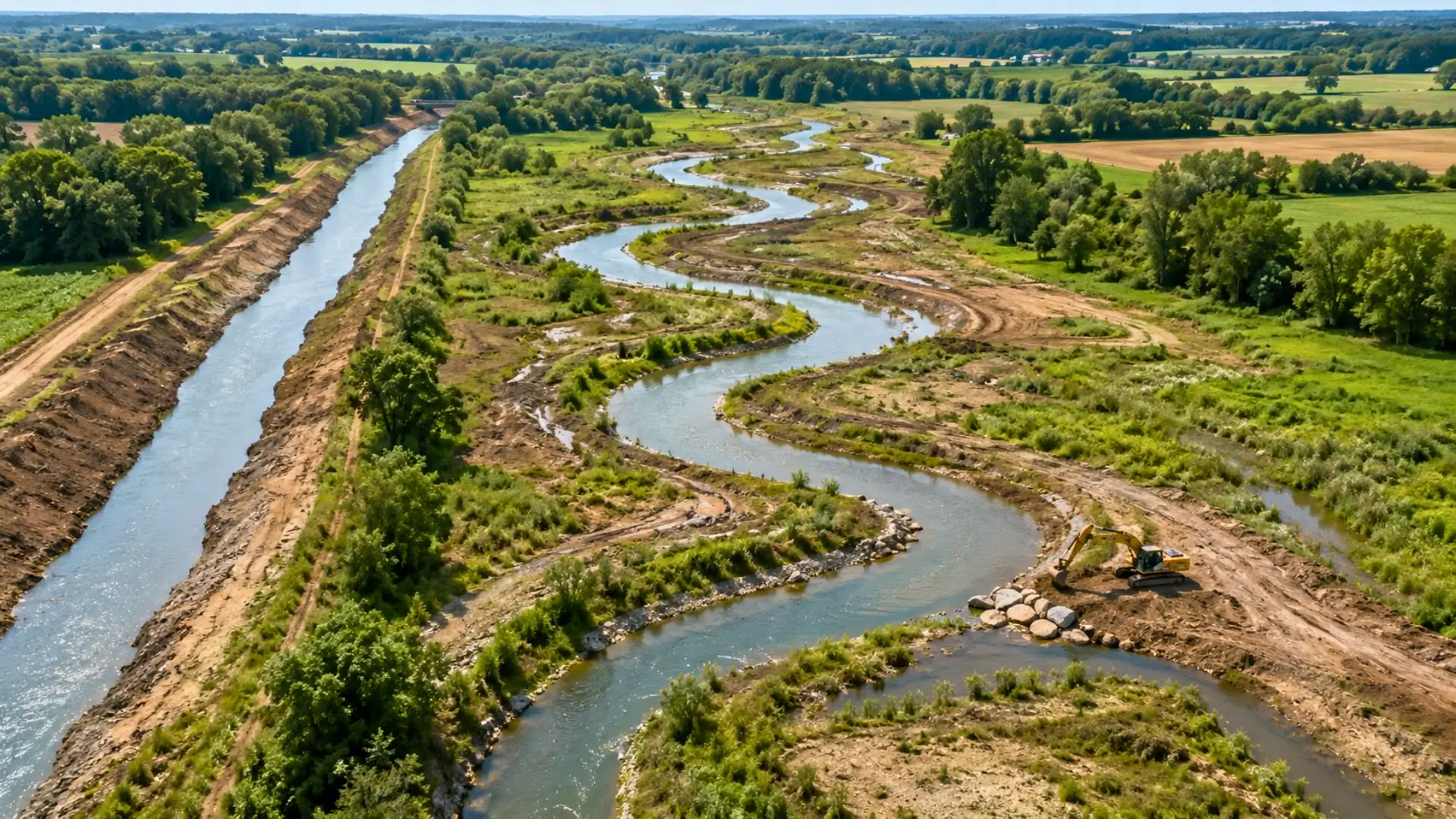
For decades, the state straightened waterways to modernize agriculture. Today, this artificial transformation worsens floods and destroys biodiversity. Faced with the damage, public authorities are now spending fortunes to restore rivers to their original curves.
How postwar agricultural modernization turned our rivers into artificial channels
Between 1955 and 2000, France pursued a methodical policy of straightening its waterways. Engineers sought to optimize plots for the machines of intensive agriculture. This massive recalibration ultimately destroyed aquatic ecosystems over thousands of kilometers.
Currently, only 45 % of surface water bodies show a good ecological status in the country. These dug and artificially straightened beds accelerate warming and promote siltation. Less than one river in two thus manages to fulfill its natural regulatory role.
The exorbitant cost of renaturation to manually recreate the erased meanders of the hydrographic network
Repairing these environmental mistakes now imposes a major financial burden. Water agencies devote 10 to 20% of their budgets to them, i.e., about half a billion euros per year. Local authorities and private individuals also contribute massively to financing these projects.
On the ground, reshaping rivers requires substantial earthworks and land acquisitions. This complex technique carries an average cost of one million euros per kilometer. For example, restoring the Petite Veyle in Biziat costs between 600,000 and 700,000 euros per kilometer.
Moreover, government impetus has accelerated recently thanks to the Water Plan and subsidies from the Green Fund. In 2024, more than 1 100 projects received aid of 142 million euros. In total, the overall value of approved operations exceeds one billion euros.
Why renaturation effectiveness remains mixed despite massive state investments
Despite these colossal budgets, the impact on fauna and flora often disappoints scientists. A broad analysis of 7 000 projects assigns an effectiveness score of 0.15 out of 1 to the interventions. Locally changing the shape of a riverbed proves insufficient if upstream pollution persists.
Nevertheless, some targeted projects demonstrate real environmental usefulness. In Occitanie, the restoration of the Vistre river has enabled the return of freshwater organisms. Moreover, these measures helped to retain 40 000 m³ of water in wetlands, thereby protecting homes from floods.
The immense ecological restoration project awaiting the French river network by the end of the decade
National ambitions are enormous for the coming years. France has committed to restoring 50 000 kilometers of waterways by 2030. This gigantic distance illustrates the scale of the task and underscores the severity of the transformations inflicted on aquatic environments in the past.
Yet, the engineers of previous decades believed they were acting for the common good by installing dikes and riprap. Their primary aim was to secure agricultural production and limit floods. Unfortunately, this short-sighted vision disrupted the natural dynamics of the rivers.
Ultimately, this crisis shows that a preserved watercourse is far more resilient to climate fluctuations. Avoiding altering nature would have spared colossal expenditures in current repairs. Preserving the original environment remains always the most economical and the most effective strategy in the long term.

Contact details
Address:
Farmers Forum,
36, Dominick Street,
Mullingar,
Co. Westmeath,
Ireland
Phone:
+353 (0)44 9310206
Or email us:
For technical issues please check out our FAQ's page or email - [email protected]
For general Queries email - [email protected]
Request to add event to our Calendar - [email protected]
Send us your mart reports - [email protected]
Suggestions and feedbacks - [email protected]
News Items / Press Release - [email protected]
To Advertise on Farmers Forum - [email protected]