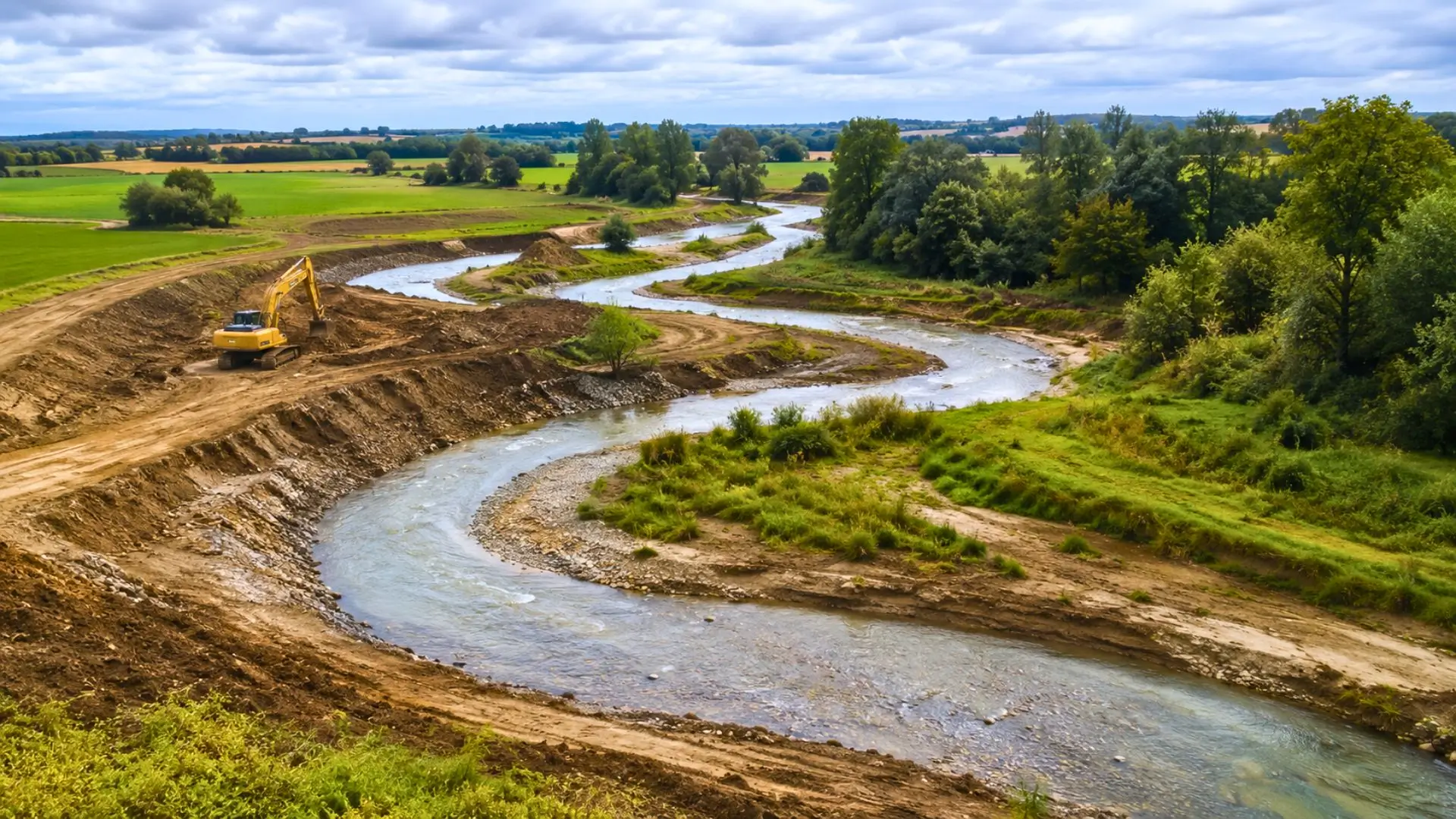
In the second half of the 20th century, thousands of kilometers of waterways were straightened to support intensive agriculture. Now, the state is funding expensive renaturation works to recreate these vanished curves—a crucial but complex ecological shift.
A sweeping agricultural modernization that transformed and weakened France’s aquatic ecosystems
Between 1955 and 1975, authorities carried out extensive land consolidation operations. To ease the passage of machines and optimize space, technicians widened, deepened, and stripped rivers of their natural curves in a methodical way.
This radical reconfiguration extended into the 2000s, triggering a severe biodiversity decline. Deprived of diverse habitats, the environments suffered siltation and warming, leading, for instance, to the local extinction of trout. Fewer than half of surface waters are in good condition.
A major investment of roughly one million euros per kilometer to rectify environmental missteps
To reverse the trend, modern re-meandering techniques aim to artificially recreate the old sinuous paths. However, these earthworks prove exceedingly costly. Budgets frequently reach around one million euros for each kilometer of restored river.
Water agencies shoulder a large share of these bills, weighing heavily on local budgets. For example, the works undertaken on the Veyle, at Biziat, required between 600,000 and 700,000 euros per kilometer, covering preliminary studies and land acquisition.
The National Water Plan has multiplied these financings through the Green Fund. In 2024 alone, the total value of interventions approved by the state exceeded one billion euros, illustrating the scale of capital mobilized to rebuild what previous decades had destroyed.
Undeniable local benefits amid ongoing global effectiveness debates among scientists
Successful interventions demonstrate real local effectiveness. On the Vistre in Occitania, the return of currents has allowed the resurgence of adapted aquatic species. Moreover, the recreated wetlands absorb substantial volumes during floods, thereby effectively shielding nearby homes from inundations.
Nevertheless, a scientific analysis covering 7,000 projects tempers this assessment by assigning a very low overall effectiveness score. Altering a riverbed remains insufficient if agricultural pollution or wastewater discharges persist upstream of the restored reach.
A vast national project by 2030 to urge nature to restore its own balances
The ambitions of the ecological transition are colossal, as France plans to rehabilitate 50,000 kilometers of waterways by 2030. The program also includes bringing 5,000 physical barriers or hydraulically oriented structures up to standard to reduce flow obstruction.
Project designers do not blame the engineers of the previous century, who acted under the imperatives of farming sovereignty of their era. They simply note that repairing ecosystems now requires a holistic approach, involving all local actors.
Experience shows that technology alone cannot save a river. Specialists must work at the entire watershed scale to create an environment that enables nature to regenerate on its own.

Contact details
Address:
Farmers Forum,
36, Dominick Street,
Mullingar,
Co. Westmeath,
Ireland
Phone:
+353 (0)44 9310206
Or email us:
For technical issues please check out our FAQ's page or email - [email protected]
For general Queries email - [email protected]
Request to add event to our Calendar - [email protected]
Send us your mart reports - [email protected]
Suggestions and feedbacks - [email protected]
News Items / Press Release - [email protected]
To Advertise on Farmers Forum - [email protected]