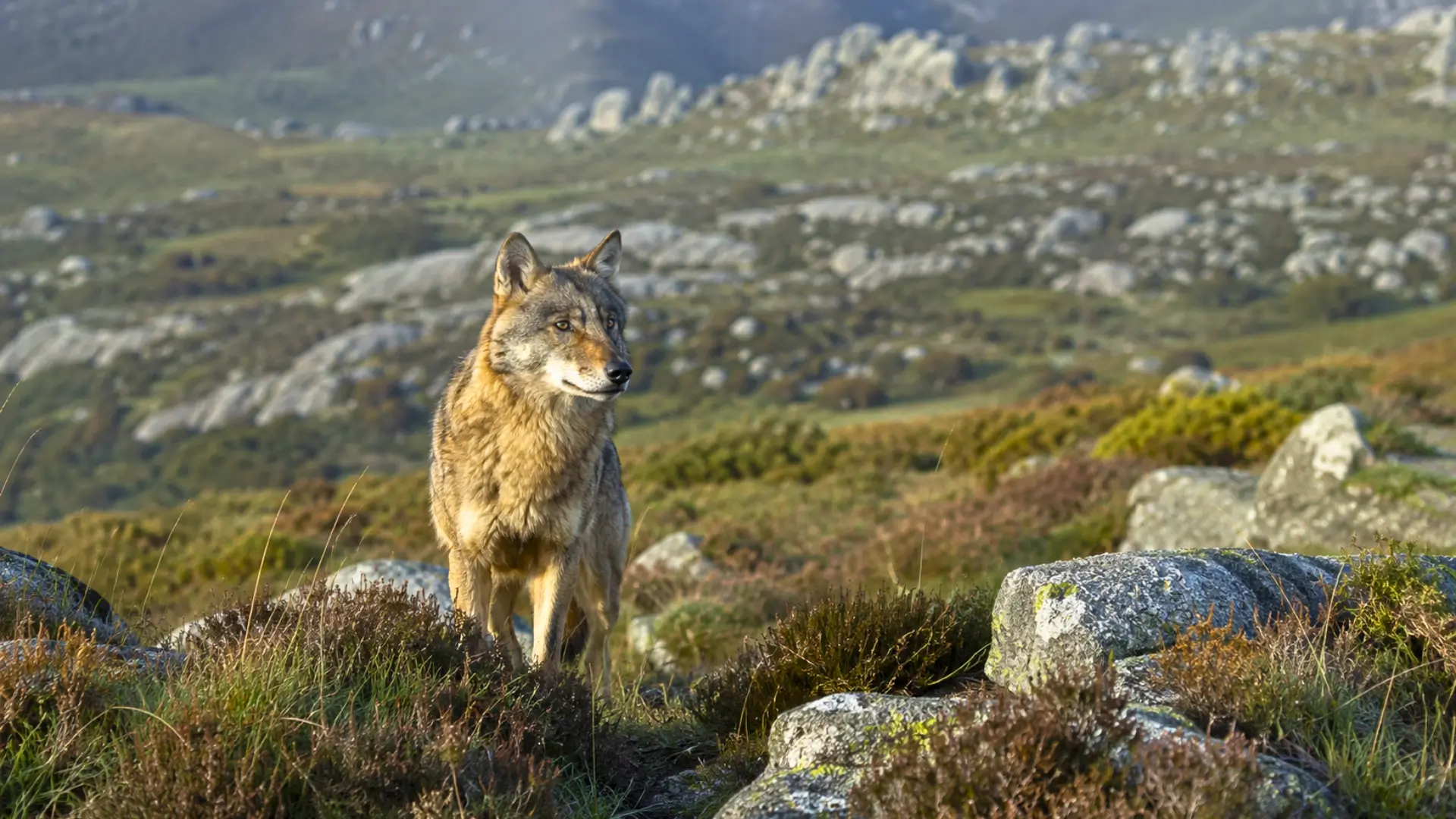
Photographed in the Arrée mountains in spring 2022, a wolf sprang into view where no one expected it. Behind this almost surreal image lies a broader story: a predator that has returned from Italy, quietly redrawing the wild map of France.
In Brittany, a Wolf Photo Reveals a Return Far More Vast Than a Simple Sighting
In the French imagination, the wolf belongs to forests of old times, to the engravings of the nineteenth century, and to Alpine herds under watch. When an individual was photographed in the Monts d’Arrée, in Finistère, in May 2022, the effect was almost cinematic. The scene surprised not only naturalists, it also unsettled a long-standing geographical certainty.
Validated by state services and relayed by the Armorique Regional Natural Park, this observation marks the first confirmed evidence of a wolf in Brittany in more than a century. From that moment onward, the detail changes everything. It is no longer a rumor, nor a misidentified large dog, but a wild animal that has returned to the very tip of the peninsula.
What is perhaps the most captivating is what this appearance quietly reveals. A young wolf in dispersal can cover hundreds of kilometers in a few months, sometimes far more. The specimen seen in Brittany echoes a simple truth: French recolonization no longer follows only the anticipated ridges; it now also travels along the margins.
From Mercantour to the West of the Country, the Wolf’s Progress Redraws the French Map
The official record begins on November 5, 1992. On that day, two wolves were identified in Mercantour after decades of absence. At the time, the phenomenon appeared local, almost fragile. Yet, in less than thirty years, the dynamic became spectacular. The French Office for Biodiversity now estimates the population at 1,082 individuals in 2025. The country also counts 97 zones of permanent presence, including 80 packs.
The figure is striking, but more importantly, it says something else: the wolf is no longer a casual visitor to the Alps. It moves, settles, and tests territories. Now, observations are validated well beyond the Southeast. The wolf is tracked as far as Hauts-de-France, Normandy, and Brittany. Thus, the wolf’s map looks less and less like a single alpine patch and more like a network.
In the Newly Touched Territories, the Wolf’s Arrival Upends Herding Practices
Consequently, this movement profoundly reshapes the nature of the debate. In the Alpine massifs, coexistence with the wolf has existed for years. It has its tensions, its know‑how, and its equipment. In the recently affected regions, however, the predator’s arrival takes breeders by surprise. They do not always have protection dogs, nor suitable fences, nor the habit of nocturnal vigilance.
This is precisely where numbers stop being abstract. In Finistère, damage assessments have piled up since 2022, signaling that Brittany’s appearance was not a mere interlude. Nationally, the OFB notes that in 2025, 87% of attacks on livestock occur in non-protected areas. The front of colonization is therefore also a front of unpreparedness.
In Aisne, in Haute-Marne, and in other northern departments, vigilance cells are multiplying. They monitor signs and, at the same time, anticipate the impact on farming. The wolf never comes alone. It is accompanied by expert assessments, administrative tensions, presence maps, and compensation schemes. Ultimately, the same question recurs: are we ready to live with it?
The Return of the Wolf Is Accompanied by a Deep Transformation of French Countryside
The wolf’s return is not merely a noble tale of nature reclaiming its rights. It reveals a country that has indeed changed. Populations of roe deer and wild boar provide abundant prey. At the same time, some rural areas are emptying or closing down. Where human activity has diminished, “quiet corridors” are gradually reconstituted, almost without political intent.
It also tells of a Europe reconnected for large predators. The wolf genetically identified in Brittany in 2026 had come from a pack in Belgium’s Hautes-Fagnes. This proves that flows no longer originate solely from Italy. Moreover, this movement enhances genetic mixing, giving rise to a more continuous, mobile European population that is harder to confine within old mental borders.
Yet, a major fragility remains. A report from the MNHN, CNRS, and OFB, presented in September 2025, reminds us that the wolf’s future also depends on authorized culling and public management. The species is advancing, to be sure, but more slowly than before. The real surprise of the coming years may lie less in the new appearances than in the place France chooses, or does not choose, to grant it.

Contact details
Address:
Farmers Forum,
36, Dominick Street,
Mullingar,
Co. Westmeath,
Ireland
Phone:
+353 (0)44 9310206
Or email us:
For technical issues please check out our FAQ's page or email - [email protected]
For general Queries email - [email protected]
Request to add event to our Calendar - [email protected]
Send us your mart reports - [email protected]
Suggestions and feedbacks - [email protected]
News Items / Press Release - [email protected]
To Advertise on Farmers Forum - [email protected]