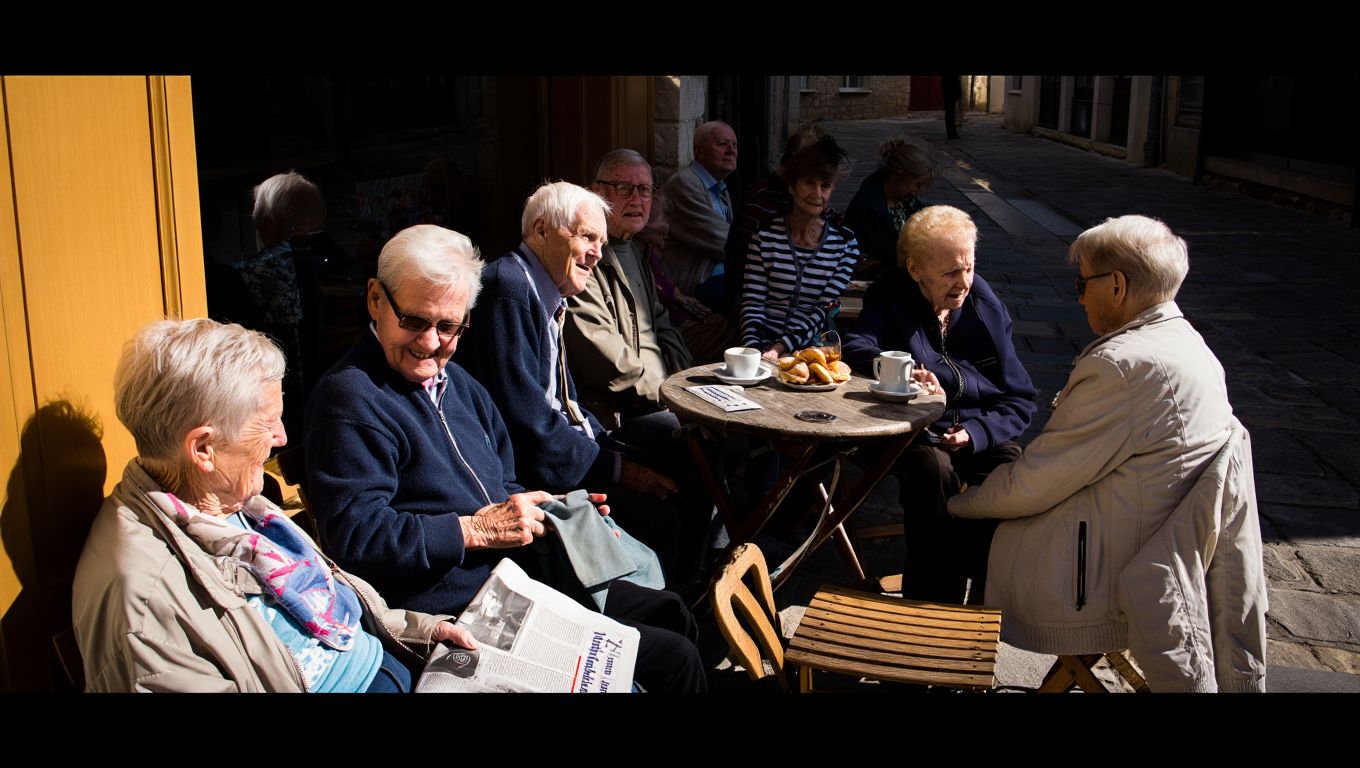
The idea of swapping rain for radiance no longer automatically points west across the Iberian border. Increasingly, Irish retirees are drifting toward a gentler corner of southern France, drawn by quiet rhythms, accessible healthcare, and village life that still feels authentic without being remote or rustic.
The pull of Occitanie’s quiet belt
Between Narbonne and Perpignan, the Aude and Pyrénées-Orientales offer wide skies, vineyard valleys, and seaside towns that hum rather than blare. The pace is slower, the scale human, and the seasons still shape the calendar: markets on Wednesdays, grape harvests in September, and tramontane winds that sweep the air to a crystalline blue. As one new arrival from Galway put it, “I wanted heat without the hassle, a glass of wine without the noise—this is exactly that.”
Why not Spain?
For many, the answer is simplicity and feel. Spain is beloved, but parts of it can feel more crowded and geared to tourism than some retirees would like. Occitanie’s coastal plain and nearby hills deliver warmth with a more low-key social scene, the language is welcoming to learners, and the food culture prizes seasonality over spectacle and speed. “Spain looked easier on paper,” says one retiree, “but here I felt looked-after the moment I stepped into the village pharmacy.”
Sunshine with a softer edge
The climate is Mediterranean, with long, dry summers and bright, breezy winters that allow for January café tables in the sun and April walks among garrigue herbs. Proximity to the Pyrenees means real mountains an hour away, so summer sea swims can share a calendar with spring ridge hikes. Even high season feels calmer than the Côte d’Azur’s high gloss, while shoulder seasons deliver the sweetest days for markets, vineyard picnics, and leisurely rail trips.
Getting there—and getting around
Access is easier than many imagine, with seasonal direct flights from Dublin to Toulouse, Béziers, or Carcassonne, and steady connections via Paris to Montpellier and Perpignan. The TGV glides from Paris to Narbonne in a handful of hours, and local TER trains stitch together beaches, towns, and villages without the stress of motorway driving. For day-to-day life, a small car helps in wine country, but many settle near train stops and walk to markets.
Community over spectacle
This part of France rewards participation, not performance or posturing. The week has a rhythm: bread runs in the morning, apéro under plane trees at dusk, and music nights in the village square when the mayor’s loudspeaker says allez. The Irish tend to blend, buoyed by English speakers who arrived earlier and by locals who relish a chat about rain in Dublin versus wind in Leucate. “I joined the choir with terrible French and left with better friends,” laughs a retired nurse, “and that felt like the right kind of progress.”
Practicalities that actually work
As EU citizens, Irish retirees avoid the visa tangle facing some other nationals, which makes long-term planning clearer and calmer. Many state pensioners can use the S1 route to access the French healthcare system, registering for a Carte Vitale and choosing a local médecin traitant. Pharmacies are ubiquitous, GPs are approachable, and specialists in Narbonne, Perpignan, or Montpellier are within realistic reach. Banking, utilities, and insurance are manageable with a little French and a lot of patient smiles.
Property and cost without the sticker shock
Housing is where the region quietly shines: stone village houses near the canal, town apartments with shady balconies, and small villas edged by olive trees. Prices remain more forgiving than Provence or the Riviera, and renovation culture is alive but less a frenzy than in saturated hotspots. Council taxes are typically reasonable, energy upgrades are encouraged, and the market still rewards walkability over raw square footage.
Everyday pleasures, not bucket lists
You move here for mornings that start with peaches and newspapers, and for evenings that end with cicadas and rosé. The pleasures are repeatable: anchovies in Collioure, olives from the Minervois, a Sunday flea market where you spend more time talking than buying. “I didn’t want to chase sights,” one retiree told me, “I wanted to build habits—and I’ve built a few good ones.”
What’s pulling Irish retirees to Occitanie
- Slower, village-scale living with real community
- Mellow Mediterranean climate and mountain escapes
- Direct or easy travel links via flights and high-speed rail
- Strong public healthcare access for eligible pensioners
- Better value in housing than glitzier southern coasts
- Culinary and cultural depth without tourist fatigue
A gentle landing for a new chapter
If you want warmth without the carnival, and routine without rut, this strip of southern France offers a soft landing. The days are unhurried, the bureaucracy is navigable, and the neighbors are more likely to bring you figs than ask why you’re here. For many Irish pensioners, that’s enough: a slower beat, a brighter window, and the reassuring sense that life can be more present when it’s lived a little more slowly.

Like most reporters you paint a very rosy picture. You have a duty to elderly people to provide a more balanced article. Having lived here for over 20 years what you say is somewhat true.
Great article. I am Irish living on the Isle of Man. Quite a few Irish living on IoM. Lovely in summer but awful in winter, so hence reading your article with interest.
Thanks George for some perspective,
The fact you’ve chosen living there telling its own story.
Obviously, holiday brochures and estate agents palaver need to be taken with a grain of salt.
I’m Irish living in Peloponnese in Greece.
For those considering a retirement move, I’d say Greece is also an interesting option. Somewhere within reasonable driving distance of Athens is easily accessible all year round. There is a growing English speaking expat community. Greeks also have generally food levels of English, certainly in pharmacies, doctors, banks, etc. Cost of living is less than France or Italy, and equivalent properties cheaper.
Winter is still better than Irish summer. Yet inland an hour away we have ski resorts. Just July and August are increasingly unbearable.
In addition, the Irish community around Athens is small enough to be friendly and welcoming.