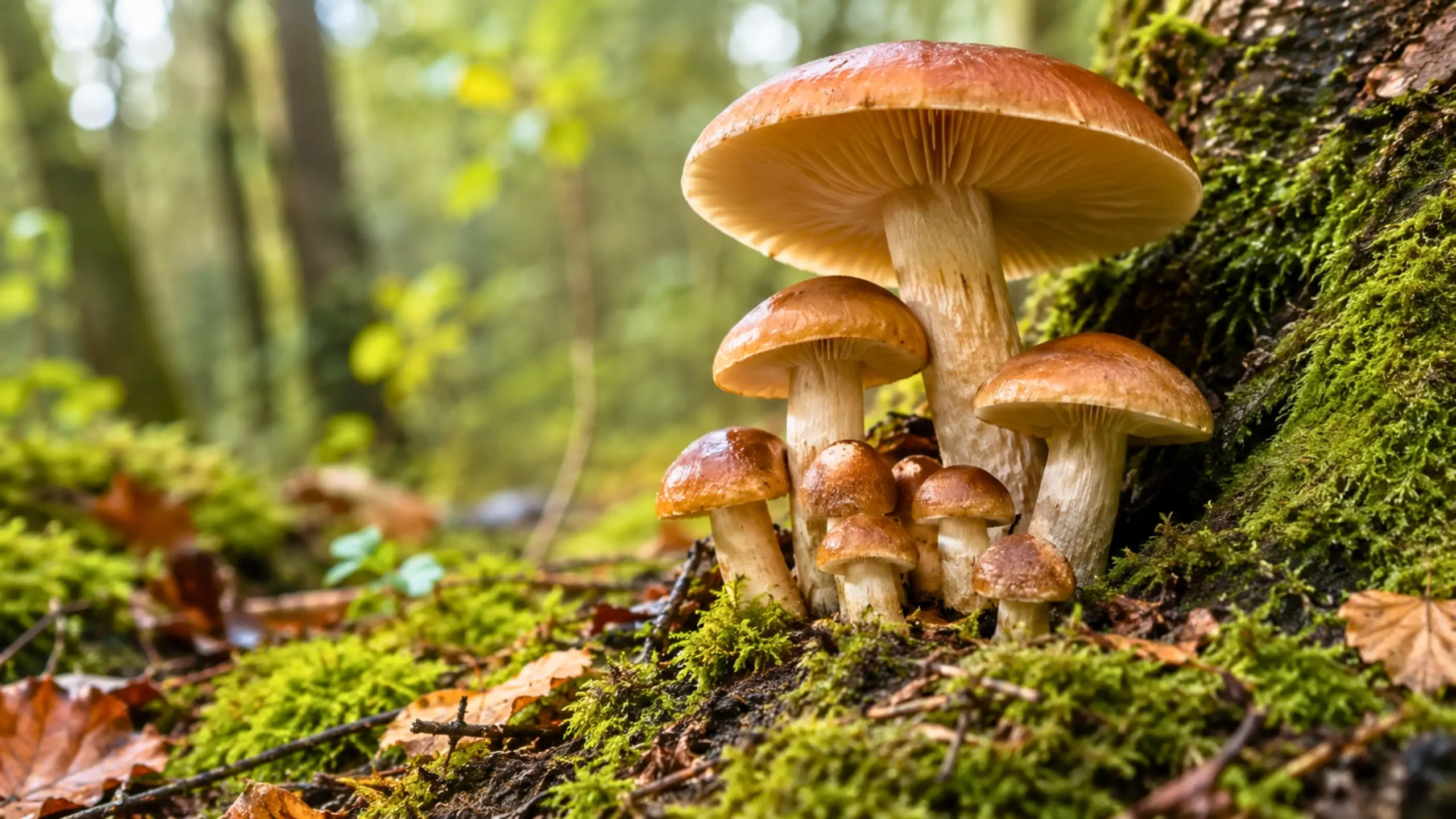
Despite their long-standing presence in the fruit and vegetable aisle, mushrooms share almost nothing with the plant world. DNA analyses reveal an unexpected biological kinship with the animal kingdom. Here’s how science is overturning our culinary certainties.
The End of an Old Optical Illusion: Placing Mushrooms in Their Own Kingdom
For centuries, the apparent immobility of these organisms misled observers, who grouped them with non-flowering plants. Yet this purely visual criterion lacked scientific rigor. It was the researcher Robert Whittaker who formally proposed, in 1969, to isolate these living beings in a distinct category called Fungi.
That separation was solidified thanks to advances in modern molecular biology. Today, the scientific community unanimously acknowledges the existence of the kingdom of Mycota. Specialists now focus on the deep ties that bind these organic structures more tightly to animals than to plants.
Precise Biochemical Clues and a Distant Cellular Kinship Shared with the Animal World
Three concrete elements confirm this closeness. First, their envelope contains chitin, that rigid substance also used to fashion the shells of crustaceans and insects. In contrast, plants rely on cellulose to build their cells, a chemical formula utterly distinct from theirs.
Moreover, their energy metabolism bears a strong resemblance to ours. These organisms store their sugar reserves as glycogen, just like human muscles, whereas plants produce starch. Finally, lacking chlorophyll, they breathe oxygen and emit carbon dioxide.
On the tree of life, a large family named Opisthochontes brings together animals and fungi. Their cells share a precise anatomical feature, namely a flagellum positioned at the rear, akin to that of sperm. Our common ancestor would date back to roughly 1.3 billion years.
The Underground Lattice of Mycelium Quietly Shapes Forest Ecosystem Survival
The visible portion that we harvest in the forest represents only the reproductive organ of the organism. The essential structure unfolds underground through the mycelium, an immense network of microscopic filaments. This discreet web colonizes the soil and performs a vital job out of sight.
Indeed, more than 90% of terrestrial plants rely on this association known as the mycorrhizal symbiosis. This underground connection dramatically multiplies the absorption capacity of trees, sometimes expanding the surface explored by their roots by a thousandfold. The stability of forests hinges entirely on this invisible biological alliance.
An Immense, Largely Unexplored Scientific Territory Home to Millions of Unknown Species
To date, science has cataloged between 200,000 and 300,000 distinct species across the planet. Yet this immense variety represents only a minuscule fraction of reality. Estimates place the total number of existing specimens at around 1.5 million species.
This colossal volume stands as double the total number of all plants and animals already identified on Earth. Consequently, about 94% of mushrooms would still remain to be discovered and named. The scope for progress is enormous for contemporary researchers.
Historically, the misclassification of this field under conventional botany has greatly hampered research. Today, mycology finally earns its rightful status as an independent science. Reframing our view of these organisms opens up exciting scientific horizons.

Contact details
Address:
Farmers Forum,
36, Dominick Street,
Mullingar,
Co. Westmeath,
Ireland
Phone:
+353 (0)44 9310206
Or email us:
For technical issues please check out our FAQ's page or email - [email protected]
For general Queries email - [email protected]
Request to add event to our Calendar - [email protected]
Send us your mart reports - [email protected]
Suggestions and feedbacks - [email protected]
News Items / Press Release - [email protected]
To Advertise on Farmers Forum - [email protected]