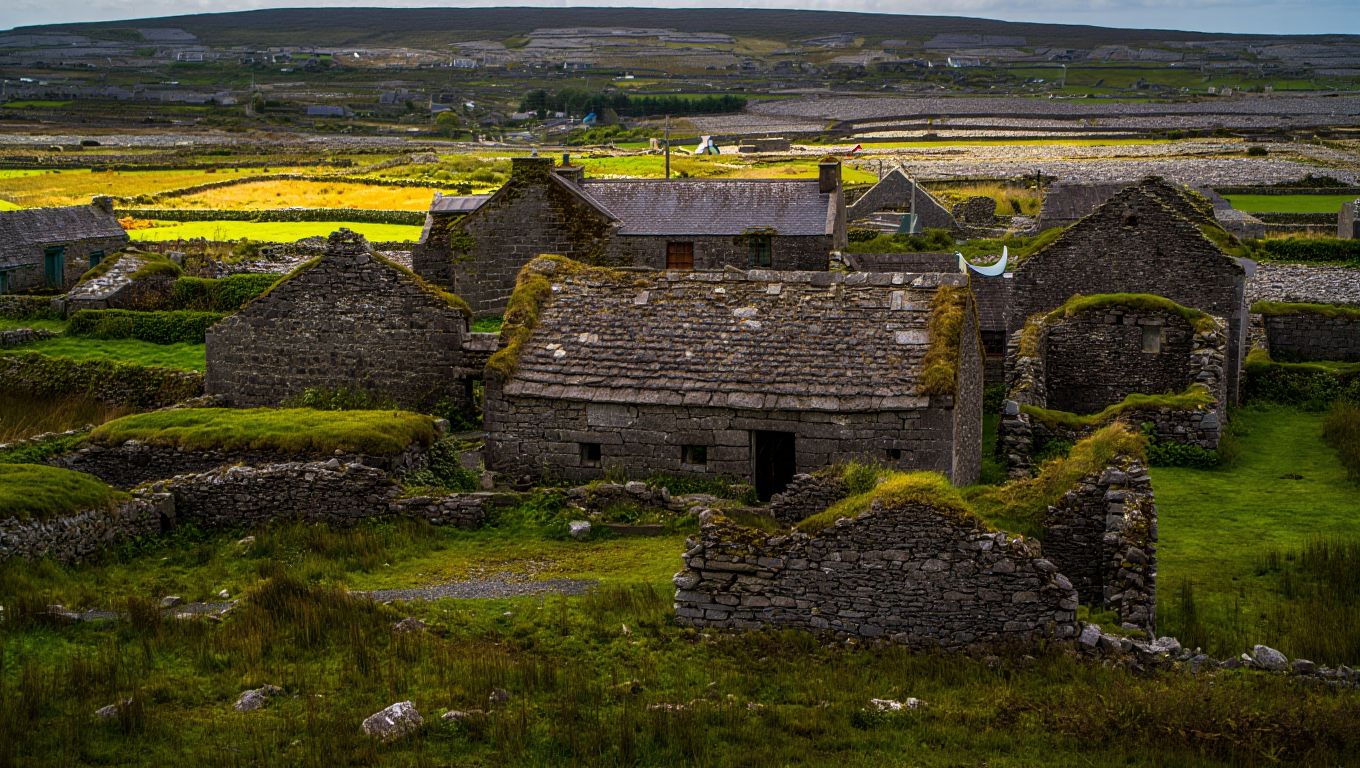
The Burren has a way of rearranging your sense of scale. Limestone terraces step toward the sea, wildflowers ignite the cracks, and wind pulls ancient stories from rock. Somewhere among these pavements, a pocket-size hamlet has just been tapped as one of the country’s most cherished secrets, and locals are quietly proud that the place still feels like itself.
No tour buses, no turnstiles, no crescendo of selfies. Just lanes walled in stone, a ruin that breathes, and a rhythm that feels older than your watch. “We’ve got time here,” says a soft-spoken shopkeeper. “And we’d like to keep it.”
Stone upon stone
Everything here is lithic, and everything is lived-in. Cottages sink their shoulders into the wind, mortar shy as lichen. Door lintels bear chisel scars and the lanes remember feet that have long gone quiet. The architecture isn’t picturesque so much as practical, made to shrug off squalls and hold heat.
On the outskirts, the land unfolds into clints and grikes, those chessboard slabs where orchids take root in pockets of soil. In the evening, the limestone blushes pink and blue, and every wall throws a shadow like a sundial no one wound.
Medieval bones, beating heart
The village’s spine is a small 12th-century church, roofless but resonant. Sparrows nest in the tracery, and a battered cross leans like a shepherd in the grass. “You can hear hammer taps in your head if you listen,” a caretaker whispers. “Masons and monks, working the same stone the fields still know.”
A low bawn shelters a courtyard where herbs perfume the air, and somewhere a fiddle draws a line between then and now. Remnants of a tower house hover in the periphery, a silhouette that anchors the horizon the way a keel steadies a boat.
People of the pavement
Despite the hush, the place is lively the way a hearth is lively. A baker turns out soda loaves from an oven so old it has a personality, while a farmer trundles by with a trailer of hay and hellos. “We don’t advertise it,” one elder shrugs. “We mind it, and it minds us.”
Evenings collect at a pub where the door is never quite closed. Fiddles spark, bodhráns hum, and someone sets a poem on the table beside a pint. Laughter arrives late and lingers long, drifting home under skies so dark they reveal the architecture of the Milky Way.
Wildflowers and weather
Between spring and summer, tiny alpine stars—spring gentian, mountain avens—pop from the limestone like punctuation in an unwritten sentence. In autumn, hazel thickets rustle with moths, and winter carves clarity from the wind’s edge. The climate feels bracing, yet the soil hoards heat under the stone, and life makes a bargain with every passing front.
“Out here, weather is a language,” a guide murmurs. “Clouds make promises, and the rock keeps them.”
How to arrive softly
This place doesn’t perform; it persists. The reward is greatest if you match its tempo and lean into quiet care.
- Walk the old green roads, keep to existing paths, and step lightly on the pavements; pack out what you bring, greet those you meet, and let your map be curiosity rather than conquest.
Small rituals worth keeping
Start with a morning wander before the breeze wakes. Listen for corncrake rasp in nearby meadows, then trace a loop along the low stone walls, fingertips on cool blocks that have outlasted many wars and most of our modern noise. Pause where a holy well tickles through fern, leave no coin, only breath.
Midday is for a mug of tea and a slab of cake, the kind that crumbles with a sigh. Read the noticeboard for news of a session, a walk, a bake sale raising euros for roof slates. By dusk, find a limestone ledge, and wait for light to fold itself into the Atlantic like a letter that knows its address.
Keeping secret, sharing care
Recognition can be a mixed gift. A place can be loved to the point of loss. “We want visitors,” says a local farmer, “but we want them to be guests, not consumers.” That means fewer geotags, more gratitude; fewer demands, more listening.
If you need a base, nearby market towns have beds and buses, and the village remains itself—a neighbor, not a stage. Come on foot if you can, or by bike when the wind is kind. Bring layers, bring patience, bring the willingness to let the landscape set the agenda.
A secret is only beautiful if it is safe. Among these stone fields, safety looks like respect, slow steps, and the simple grace of stepping aside so the place can keep being home first, and a story for the rest of us only after.

Contact details
Address:
Farmers Forum,
36, Dominick Street,
Mullingar,
Co. Westmeath,
Ireland
Phone:
+353 (0)44 9310206
Or email us:
For technical issues please check out our FAQ's page or email - [email protected]
For general Queries email - [email protected]
Request to add event to our Calendar - [email protected]
Send us your mart reports - [email protected]
Suggestions and feedbacks - [email protected]
News Items / Press Release - [email protected]
To Advertise on Farmers Forum - [email protected]