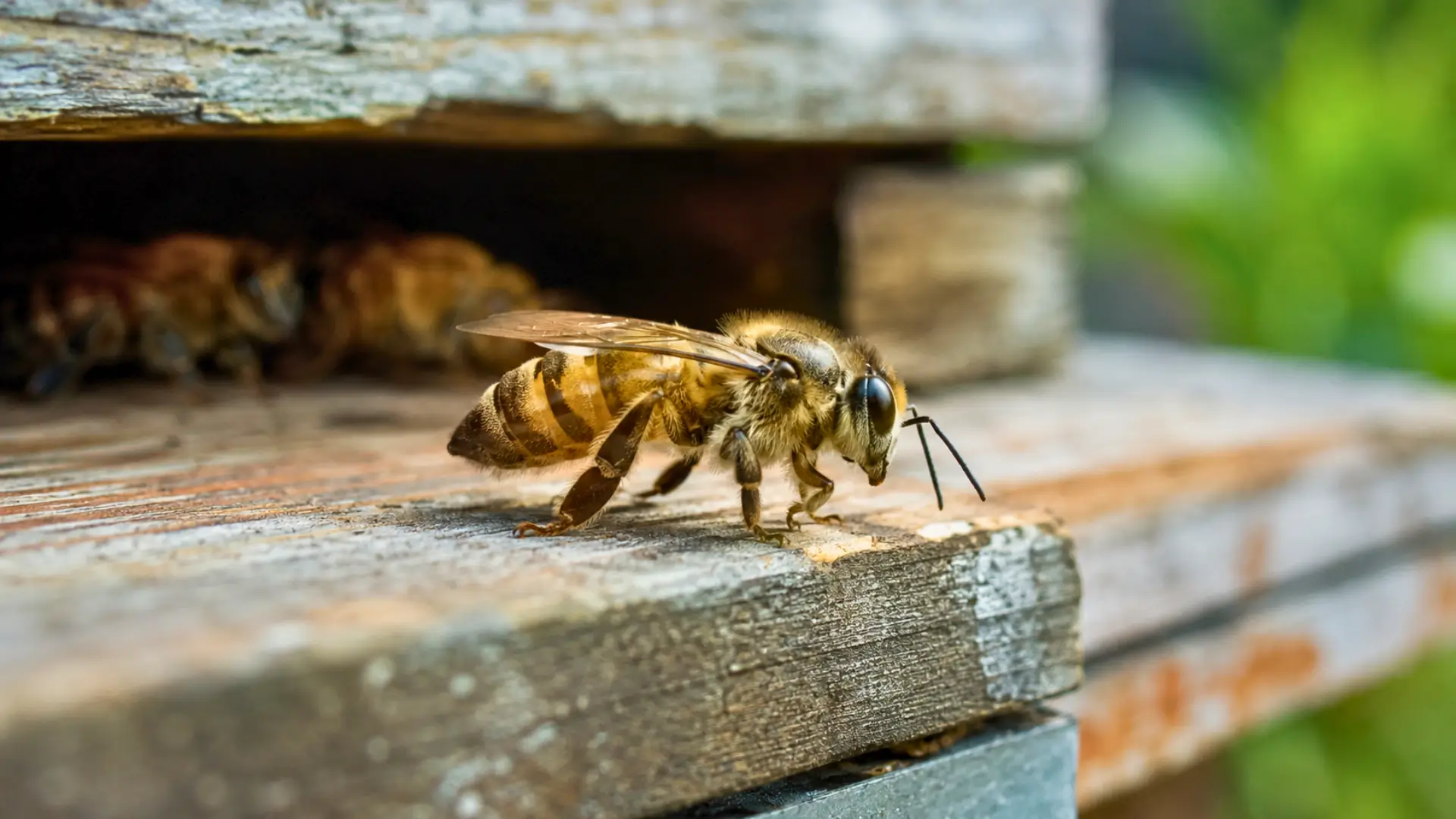
Born from a Brazilian experiment aimed at saving honey production, Africanized bees have advanced for nearly seventy years. Their venom isn’t any more formidable, but their collective defense fascinates as much as it unsettles. And with milder winters, their reach could widen even further.
In Brazil, an ambitious beekeeping experiment escapes the control of researchers
In the 1950s, Brazil searched for a bee able to work under tropical heat. European lineages, by contrast, wore out under those conditions. So, the geneticist Warwick Estevam Kerr imported African queens, reputed for their robustness and productivity. On paper, the idea seemed elegant: to cross endurance with docility to produce a honey champion.
But biology sometimes has a sense of drama. In 1957, near Rio Claro in the state of São Paulo, 26 queens escaped after the protective grilles were removed. They then mated with local males. In a matter of weeks, the controlled experiment became a wild adventure, with no turning back.
A bee not more venomous, but far quicker to defend its hive
The Africanized bee is not a laboratory monster. Nor is it a creature with exceptionally potent venom. Agricultural extension services in the United States, such as Oklahoma State University, remind that its isolated sting is not stronger than that of a European honeybee. Yet the danger does exist. It comes from elsewhere.
In reality, these bees defend their colony with spectacular intensity. Where a European hive may send only a handful of guards, an Africanized colony can mobilize hundreds of individuals. It can also pursue longer and react to faint vibrations. The National Park Service insists: they do not seek to kill, they protect their nest with extreme vigilance.
These behavioral differences fed their Hollywood reputation. Thus, the nickname “killer bees” spread through media, with its B-movie undertone and mass panic. Yet beyond the sensational label lies a ecological lesson. A trait advantageous in a predator-rich environment can become explosive elsewhere.
Swarms capable of crossing a continent at an impressive pace
After their appearance in Brazil, the swarms moved up the continent at an impressive pace. Their progression is sometimes estimated at between 300 and 500 kilometers per year according to several popular science syntheses. Gradually, South America, Central America and Mexico witnessed this living map advance, carried by mated queens and swarming colonies.
The United States officially encountered these bees in Texas in the early 1990s. Since then, they have established themselves in several hot Southern and Southwestern states. For beekeepers, the stakes are real: monitoring lineages, replacing certain queens, and preventing genetic aggressiveness from taking over professional apiaries.
Warmer Winters Could Push Back the Natural Boundary of Their Expansion
For a long time, cold weather acted as a natural gatekeeper. Indeed, Africanized bees struggle with harsh winters, as they remain adapted to tropical regions. But this limit becomes less defined as the seasons warm. Models cited recently by Popular Mechanics suggest a possible progression south of the Appalachians and into parts of Oregon.
This movement tells not only the story of an invasive insect. It also reminds us that climate change is modifying biological neighborhoods. Thus, species, crops and risks once separated by temperature move closer together. A hive, a stroll, a farm or a natural park can then become sites of unforeseen encounters.
There remains a highly current perspective: learning how to limit the risk without turning the insect into a scarecrow. Experts already rely on public information, hive management, and caution near nests. For in the living world, human errors rarely disappear; they simply move to a new territory.

Contact details
Address:
Farmers Forum,
36, Dominick Street,
Mullingar,
Co. Westmeath,
Ireland
Phone:
+353 (0)44 9310206
Or email us:
For technical issues please check out our FAQ's page or email - [email protected]
For general Queries email - [email protected]
Request to add event to our Calendar - [email protected]
Send us your mart reports - [email protected]
Suggestions and feedbacks - [email protected]
News Items / Press Release - [email protected]
To Advertise on Farmers Forum - [email protected]