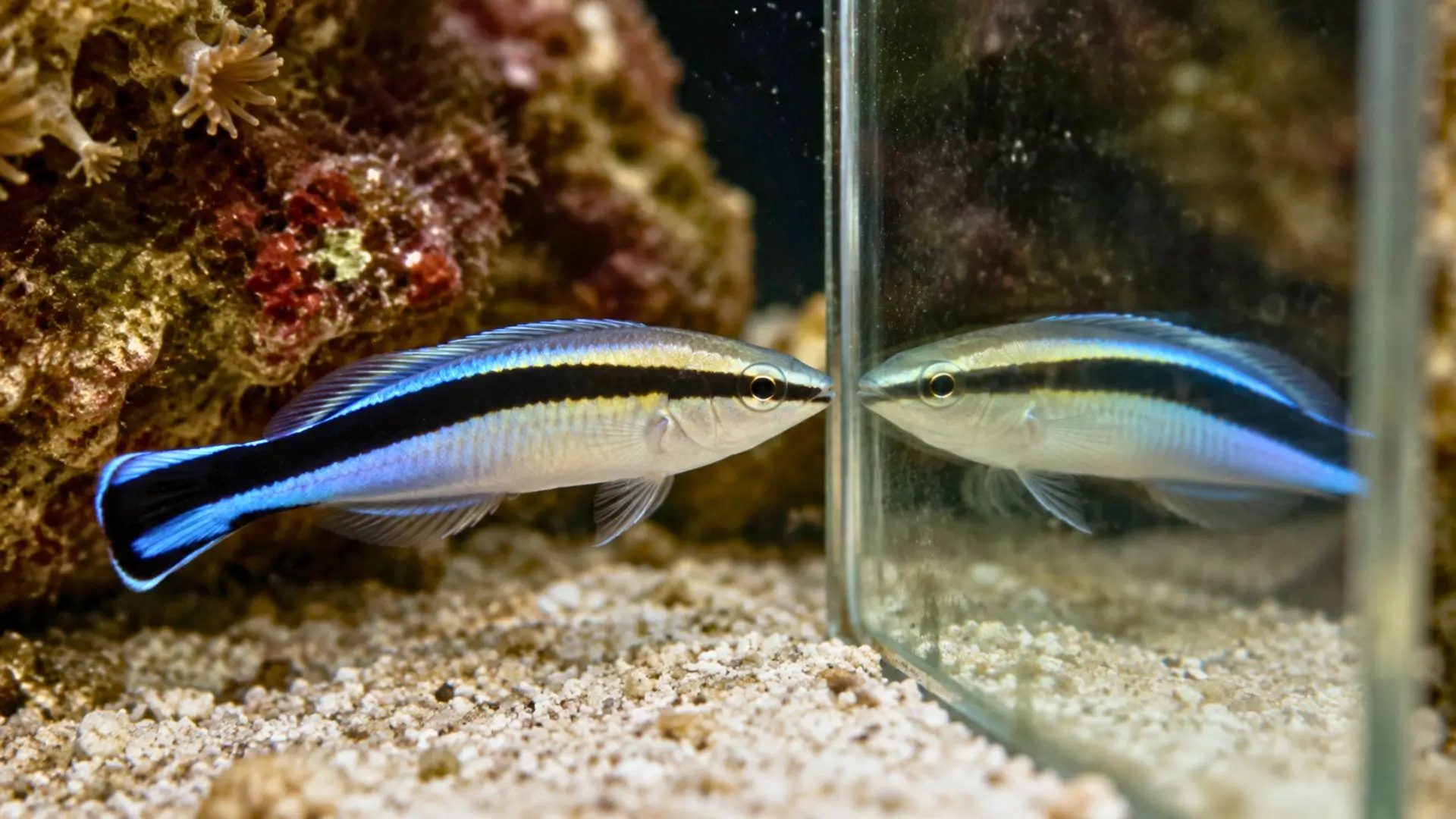
A fish shorter than a pen can recognize itself in a mirror. The cleaner wrasse, studied by Masanori Kohda and his team at Osaka Metropolitan University, is forcing researchers to reread a test long reserved for the brainiest minds.
The mirror test does not merely verify a reflection; it observes how an animal links the image to its body
The mirror test rests on a simple idea. A mark is placed on a body area the animal can only see through its reflection. If it tries to remove it from its own body, researchers refer to visual self-recognition.
This protocol comes from psychologist Gordon Gallup, who proposed it in 1970 with chimpanzees. Cognitive ethology, the discipline that studies animals’ mental abilities, later used it as a benchmark to compare primates, dolphins, elephants, or birds.
Studies conducted in Osaka change the interpretation of a test used for animals for over 50 years
The team led by Masanori Kohda published an initial study in PLOS Biology in 2019. Wrasses exposed to the mirror go through three behaviors: attacking the reflection, unusual movements in front of the glass, then close observation, as seen in other species already tested.
The follow-up, published in 2022 in PLOS Biology, strengthens the case. The authors report 17 successes out of 18 fish, i.e. 94%. The throat-marked wrasses rub that area against the sand or rocks when a mirror is present.
The tricky part remains interpretation. The researchers do not claim that the fish thinks of itself as a human. They propose that the test reveals at least a link between reflection and body, finer than a simple reaction to another animal.
Recognition of a still photo shows that the cleaner wrasse does not merely respond to the mirror’s movement
A study published in PNAS in 2023 marks a different step. Wrasses that had not yet passed the test attacked their own photo as if it belonged to a stranger. After the mirror experience, they stopped attacking their own face.
This reaction matters because a photo does not move. The fish can no longer rely on the synchronization of the reflection, as a mirror imitates every movement. It seems to compare the image to a mental image, a representation kept in memory.
The researchers also tested composite images, with a separate face and body. The personal face played a decisive role. This precision brings the behavior closer to individual recognition, without erasing the limits of a protocol conducted in an aquarium.
Before attacking a rival, the cleaner wrasse uses its reflection to compare sizes and limit risk
The study published in Scientific Reports in 2024 adds a concrete detail. Wrasses confronted with pictures of fish 10% larger or 10% smaller do not react randomly. After the test, they more strongly avoid larger opponents.
The mirror then acts as a visual scale. The fish juxtaposes two silhouettes: its own and that of the rival. This comparison helps decide whether to attack or to back down, in an aquarium where the displayed opponent is 10% larger.

Contact details
Address:
Farmers Forum,
36, Dominick Street,
Mullingar,
Co. Westmeath,
Ireland
Phone:
+353 (0)44 9310206
Or email us:
For technical issues please check out our FAQ's page or email - [email protected]
For general Queries email - [email protected]
Request to add event to our Calendar - [email protected]
Send us your mart reports - [email protected]
Suggestions and feedbacks - [email protected]
News Items / Press Release - [email protected]
To Advertise on Farmers Forum - [email protected]