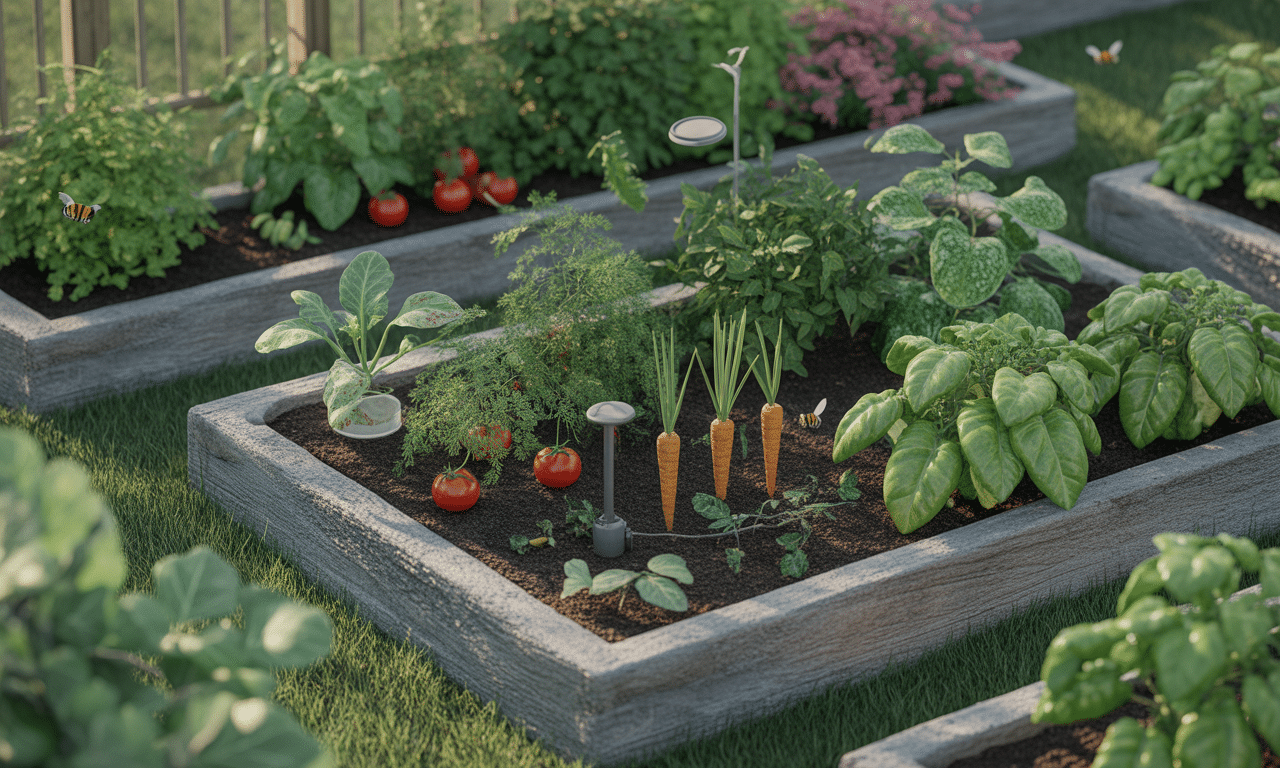
Starting an ecological garden at home in 2026 is now a choice that is both pragmatic and civic. Faced with health concerns related to pesticides and the fragility of food supply chains, growing your own vegetables allows you to control the quality of what you eat, reduce your carbon footprint, and limit the use of chemical inputs. The trend is clear: in 2026, more than a third of French people adopt alternative cultivation practices, sign of growing support for responsible consumption. Beyond the food objective, the garden promotes local biodiversity through composting organic waste, planting hedgerows, and implementing crop rotation. It also provides a concrete response to resilience challenges: rainwater harvesting, water-efficient irrigation systems, and plant combinations reduce dependence on external resources. For city dwellers as well as rural residents, this project combines usefulness and ethics, transforming a living space into a tool for ecological transition and food autonomy.
Why choose an ecological garden
Choosing an ecological garden is not a passing fad: it is a considered decision that contrasts sustainable methods with conventional agriculture dominated by pesticides and chemical fertilizers. The main argument is simple and morally solid: growing your own produce, using environmentally respectful practices, reduces exposure to harmful residues while limiting the carbon footprint linked to supply chains. Investing time to learn how to produce vegetables and fruits without chemicals improves our health while supporting biodiversity.
Beyond personal health, there is a collective urgency. In 2026, more than 35% of the French adopt ecological cultivation methods, a sign of an informed awareness. Economically, producing part of one’s own food also helps escape the volatility of prices in supermarkets and gain in autonomy, as some writings on responsible consumption (vivredemain) outline.
The ecological argument is paired with a social and educational one: a garden becomes a place for exchange, learning and civic engagement. Approaches such as permaculture offer proven frameworks to maximize yields without harming the environment — a practice clearly explained by specialized resources (notre-jolie-maison, dynamiquecitoyenne).
Choosing ecology in one’s garden thus reconciles individual interest with collective responsibility. The benefits range from soil improvement thanks to compost to strengthening local ecosystems through the planting of species attractive to pollinators. The arguments in favor of an ecological garden also rest on a practical promise: better health, fewer inputs, greater food autonomy, and a measurable contribution to the fight against biodiversity loss.
Selecting the location and exposure
The right location conditions the success of an ecological garden. First, evaluate the sunlight: most vegetables require at least six hours of sun per day. A poorly oriented site often condemns yields and increases the use of artificial aids (greenhouses, lamps), which dilutes the ecological argument. Favoring a bright spot sheltered from strong winds is a pragmatic rule to limit losses and protect young plants.
The proximity to a water source should be central in the planning: irrigation management will be easier and less energy-intensive if a rainwater collector or a water point is accessible. Installing a tank to capture rain reduces pressure on the potable water network and fits into a durable logic — several guides recommend this approach and detail the possible savings (vivredemain).
One must also observe the surroundings: neighboring trees, buildings casting shadows, low-lying areas prone to standing water. These factors determine the choice of species and the layout (raised beds, elevated planters). A garden installed near a polluted area or too shaded by buildings quickly becomes more costly to maintain and less productive.
Finally, consider accessibility for maintenance: pathways, tool storage, nearby compost bin. An optimized layout makes mulching, hand weeding and harvesting easier — all actions that reinforce the main argument: a well-placed ecological garden demands fewer external inputs and supports the sustainability of harvests. For practical advice, local resources and feedback are available on specialized sites (viedujardin).
Preparing and enriching the soil
Soil fertility is the central concern of an ecological garden. Working the soil without chemical fertilizers requires a strategy based on adding organic matter, soil structure and microbial life. Add well-decomposed compost, integrate green manures, and lightly work the soil—these are powerful and sustainable levers.
Begin by clearing debris and weeds, then aerate the soil with a digging fork rather than aggressively turning it: the soil structure, soil life and mycorrhizal networks are preserved. Incorporating compost improves water retention, porosity and nutrient supply; studies show a significant increase in fertility in a few seasons if the input is regular.
Using local amendments such as composted manure or shredded leaves fits into the garden’s circular economy. Producing your own compost turns kitchen waste into a valuable resource and reduces the need for external inputs. Simple tests (soil clump test, moisture test) help decide whether the soil needs a major input or only light maintenance.
Think about solutions adapted to your soil type: heavy soils drained by adding organic matter and sand; poor soils enriched by compost and green manures. Concise guides offer amendment plans by season and crop and help optimize work without excessive complexity (conseils-jardinage). The argument is clear: investing in soil quality from the start reduces future chemical interventions and guarantees healthy and sustainable production.
Managing water and installing an eco-responsible irrigation system
Water is the critical resource for any ecological garden. The case for controlled management is triple: cost savings, harvest quality and resilience during dry spells. Installing a rainwater harvesting system significantly reduces the consumption of drinking water — some simple setups reduce water usage by 30 to 50 %. Using rainwater for irrigation is both an ecological and economical measure.
Drip irrigation is one of the most efficient solutions: it delivers water directly to the roots, limits evaporation and reduces foliar diseases. Adjusting watering times (early morning or late afternoon) increases efficiency. Mulching complements this management by preserving moisture and reducing irrigation needs.
Beyond techniques, the political and practical argument rests on available resources to design a system tailored to each situation — guides and feedback show how to size collectors, install filters and automate drip irrigation without disproportionate extra cost (maisonsdaujourdhui).
Considering irrigation as a central design element of the garden increases productivity and reduces environmental impact. Finally, pairing additional techniques such as lasagna beds, ground-covering plants and drought-tolerant varieties strengthens the garden’s ability to prosper with less water. These pragmatic and thoughtful choices form a strong argument in favor of ecological gardening: operational sustainability and resource management.
Encouraging biodiversity and practicing crop rotation
Biodiversity is the pillar that legitimizes the ecological argument for a garden. Practicing crop rotation and associating companion plants limit diseases, reduce pest outbreaks and maintain soil fertility. Varying vegetable families from one year to the next is one of the most effective gestures to prevent depletion and reduce inputs.
The benefits are evident on several levels: improved pollination thanks to attractive flowers, a reduction in pest populations due to natural predators, and increased resilience to climatic fluctuations. The use of selective traps, physical barriers and repellent plants constitutes a coherent and low-cost strategy (vivredemain).
Here is a practical table summarizing a simple rotation suitable for a family garden:
Adopting a thoughtful rotation and planting flowering strips favors beneficial insects and reduces dependence on treatments. Practical and technical resources help design rotations suited to your climate and soil (viedujardin, vivredemain).
Why start an ecological garden at home in 2026
Starting an ecological garden today is not simply a trend: it is a rational choice in the face of health and climate challenges. By favoring chemical-free methods, composting and promoting biodiversity, one concretely reduces risks for health and for the environment. Recent figures show massive adoption of these practices, proof that it is a collective response to real problems.
Ecologically, a home garden decreases the carbon footprint linked to transport and the industrial production of food. Adopting rainwater harvesting and drip irrigation also helps reduce water consumption in a measurable way for your household. Growing while respecting crop rotation and companion planting limits diseases and the use of inputs, preserving soil fertility in the long term.
Economically, ecological gardening is cost-effective: fewer purchases of vegetables and herbs, fewer expenditures on phytosanitary products, and a home-made compost that improves soil and reduces dependence on commercial amendments. Beyond savings, it offers a form of autonomy in food and local resilience in the face of fluctuations in food supply chains.
Finally, the human argument is decisive: gardening promotes well-being, intergenerational learning and social connection. In 2026, cultivating your ecological garden means defending healthy eating, supporting nature and investing in a useful and durable project for yourself and the community. Refusing this approach today would mean continuing a consumption detached from ecological and health realities that concern us all.
FAQ: Why start an ecological garden at home in 2026
Q: Why start an ecological garden at home as early as 2026?
R: Because a home garden combines health and environmental benefits: fresher, pesticide-free foods, a reduction of your carbon footprint, and the restoration of local biodiversity. The trend is clear: in 2026, more than a third of the French people favor environmentally respectful cultivation practices, showing that this choice is both responsible and sustainable.
Q: What concrete advantages for my health and the planet?
R: You limit exposure to chemical products, increase the share of unprocessed foods in your diet, and contribute to local carbon sequestration. Ecologically, a garden supports pollinators, improves soil structure, and reduces the need for transportation and packaging.
Q: Is it a project too time-consuming for someone in a hurry?
R: No: a ecological garden that is well designed requires a reasonable initial investment and then adjustable maintenance. Techniques like mulching, rainwater harvesting and drip irrigation drastically reduce repetitive tasks. Planning in beds or raised mounds also makes the work more efficient.
Q: How to choose the ideal location?
R: Favor a corner that receives at least 6 hours of sunlight per day, near a water source to facilitate watering, and sheltered from strong winds. Avoid zones overly shaded by buildings or dominant trees: sunlight remains decisive for yield.
Q: Where to start to prepare the soil?
R: Clear weeds, aerate the soil, then enrich it with compost or green manures. Compost improves structure and fertility: it can boost soil fertility by about 30% in two years if added regularly.
Q: Which plants are best for beginners?
R: Start with robust and fast-growing crops: lettuce, radish, green beans, courgettes, and herbs (basil, chives). Always choose varieties suited to your climate and pair plants that protect each other to limit interventions.
Q: How to water without waste?
R: Install a rainwater collector and favor drip irrigation to supply water directly to the roots. These solutions can reduce water consumption by around 30 to 50% and optimize use during dry periods.
Q: How to protect against pests without chemicals?
R: Promote biodiversity: companion planting, flowering hedges and shelters for beneficials (bees, hoverflies). Use physical methods (nets, traps), natural barriers (slug collars) and targeted interventions rather than systemic treatments.
Q: Is crop rotation really necessary?
R: Yes. Crop rotation breaks pest cycles, prevents soil depletion and limits diseases. Alternating vegetable families from year to year is a simple practice that protects long-term productivity.
Q: What tools are essential to start without breaking the bank?
R: Choose a light shovel or digging fork, a rake, a dibber, an ergonomic watering can, and pruning shears. These basic tools are sufficient for most tasks; then add as needed (irrigation system, rain barrel, compost bin).
Q: Is it possible to have an ecological garden in an apartment or on a balcony?
R: Absolutely. Containers, planters and boxes allow growing aromatic herbs, salads and small vegetables. A kitchen compost bin suited to space and a sunny spot optimize production even in a compact area.
Q: What budget should I expect and what savings could I hope for?
R: The initial cost varies with the equipment chosen, but remains moderate if you start with basic tools and seeds. In the long term, you’ll reduce purchases of vegetables and herbs, and rainwater harvesting and composting lower ongoing expenses and environmental impact.
Q: When can I expect to harvest my first vegetables?
R: Some crops like radishes or lettuce can be harvested in a few weeks, while tomatoes and squash take several months. Plan staggered sowings to ensure continuous harvests and a motivating experience from the first season.

Contact details
Address:
Farmers Forum,
36, Dominick Street,
Mullingar,
Co. Westmeath,
Ireland
Phone:
+353 (0)44 9310206
Or email us:
For technical issues please check out our FAQ's page or email - [email protected]
For general Queries email - [email protected]
Request to add event to our Calendar - [email protected]
Send us your mart reports - [email protected]
Suggestions and feedbacks - [email protected]
News Items / Press Release - [email protected]
To Advertise on Farmers Forum - [email protected]