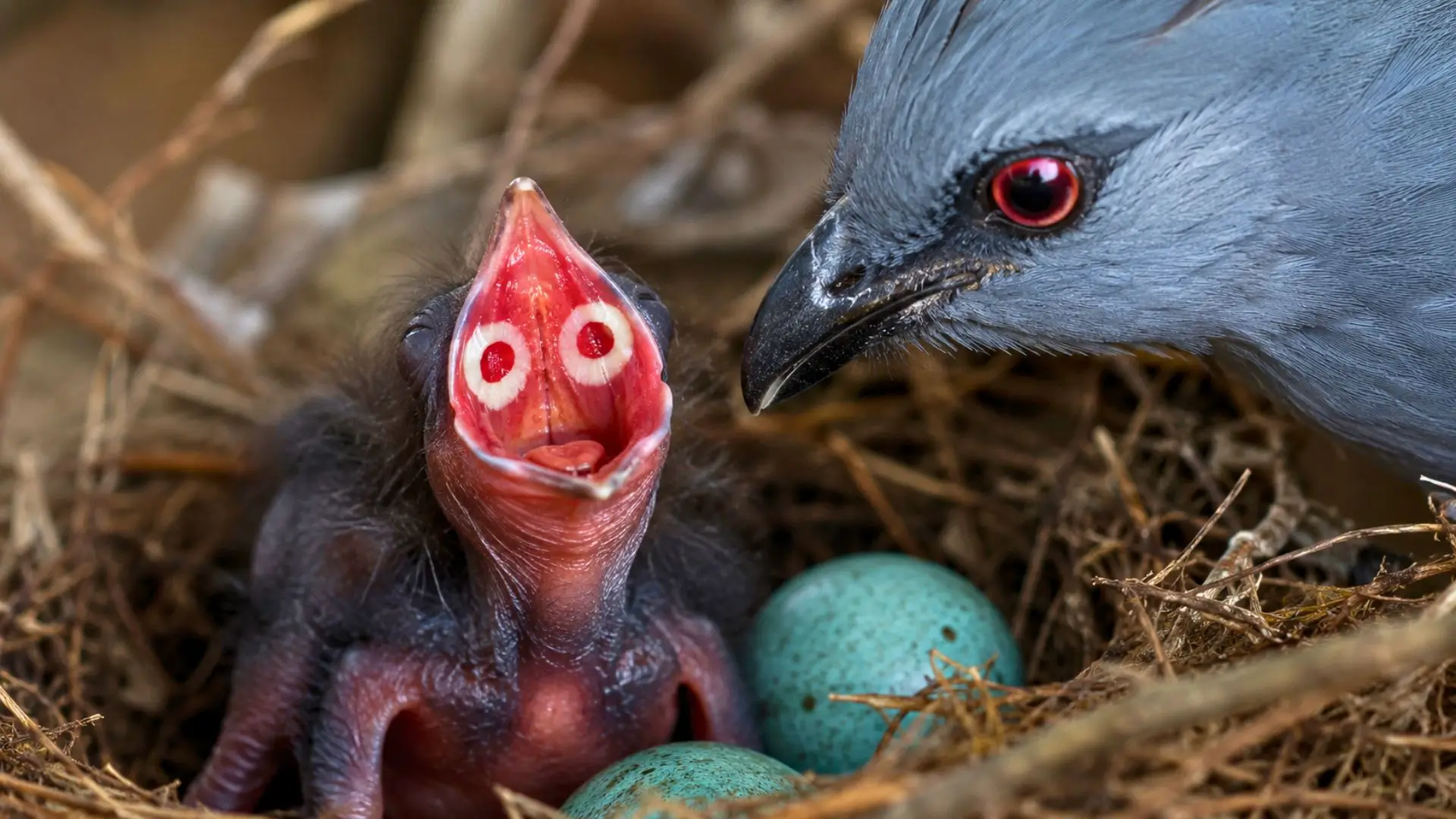
An open beak is enough to recognize the chick. For the crested coua, the red and white markings on the palate act as a very precise visual signal. The birth observed at Fort Worth Zoo in March 2026 makes this biological detail easier to see.
In the beak of the crested coua chick, a colored pattern serves as a visual cue for parents from the very first feedings
The crested coua chick does not speak, but its mouth already carries legible information. When it signals for food, red, white, and dark markings appear on the palate and tongue, like a recognition pattern placed in the right spot.
These spots draw the adult’s attention toward the feeding target. The mechanism resembles a very short visual code, comparable to the badge you show at a door. In a naked, dependent chick, this signal matters from the first meals.
Why these buccal marks matter for a bird belonging to the parasite cuckoo family
The crested coua belongs to the Cuculidae family, the cuckoos. Several species within this group practice brood parasitism, a strategy where one bird lays eggs in another species’ nest, and the resident bird then raises a foreign chick.
This tactic can tilt the balance of a brood. In certain parasitic cuckoos, the chick hatches early, grows quickly, and can push neighboring eggs out of the nest. The food brought by the adults then becomes a resource seized by the intruder.
In the crested coua, the buccal marks add a feeding filter. They are not a magical signature, but a cue that parents can read. The open beak becomes a control surface, almost as informative as a visual footprint.
The Fort Worth birth observation makes visible an adaptation shaped in Madagascar
The Fort Worth Zoo reported in March 2026 its first crested coua chicks. This birth provides keepers with a rare window into a detail often hidden in nests, visible only when the youngster opens its beak wide.
The species, Coua cristata, naturally inhabits Madagascar and reaches about 40 to 44 cm in adult life. This marker places the bird somewhere between a sturdy pigeon and a small crow. The chick, by contrast, is born dark, bare, and entirely dependent.
The marks do not endure for life. They fade as the youngster grows and no longer requires the same feeding trigger. This disappearance makes the visible window very brief, limited to the early days when every opened beak counts.
What these eye-shaped marks tell us about the evolution of parental care in birds
A chick’s mouth is not merely an hungry opening. In behavioral biology, a signaling stimulus refers to a simple cue that triggers a response. Here, the color, placement, and contrast direct the parental action toward the correct target.
This adaptation demonstrates that natural selection can operate on a minute detail. Not a longer wing or a stronger beak, but a few spots placed inside a mouth. In March 2026, in Texas, that signal rested in the open beak of a chick.

Contact details
Address:
Farmers Forum,
36, Dominick Street,
Mullingar,
Co. Westmeath,
Ireland
Phone:
+353 (0)44 9310206
Or email us:
For technical issues please check out our FAQ's page or email - [email protected]
For general Queries email - [email protected]
Request to add event to our Calendar - [email protected]
Send us your mart reports - [email protected]
Suggestions and feedbacks - [email protected]
News Items / Press Release - [email protected]
To Advertise on Farmers Forum - [email protected]