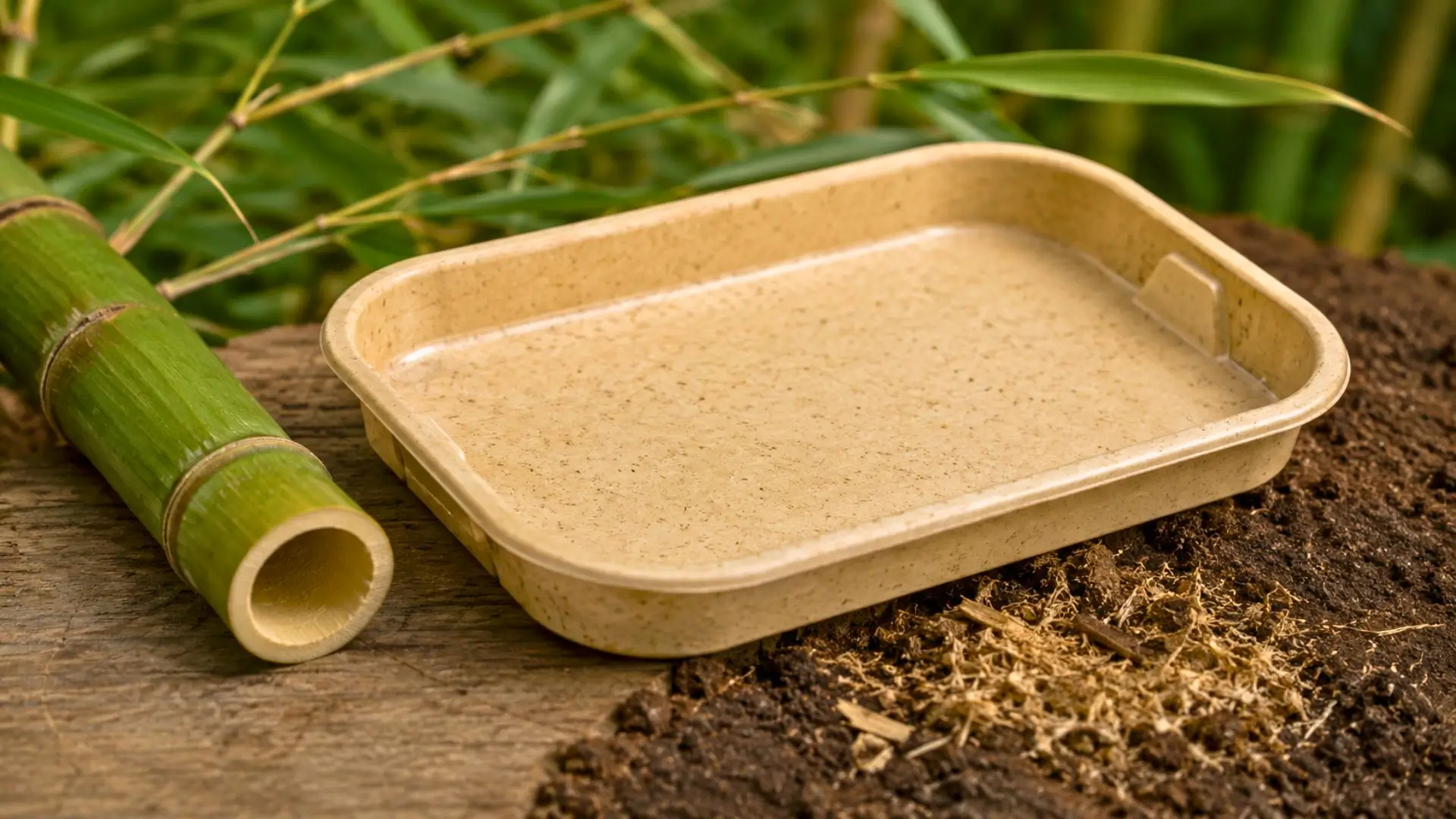
A piece of bamboo can become a rigid and moldable material. Researchers at Northeast Forestry University in China report a bioplastic that is strong, recyclable, and degrades in soil within 50 days, according to laboratory trials still underway.
Why this bamboo plastic is drawing attention from researchers and industry beyond the hype
The team led by Hongying Tang, with Dawei Zhao and Haipeng Yu among the corresponding authors, describes in Nature Communications a material called BM-plastic. Its starting point remains familiar: cellulose, the fibrous scaffold that gives plants their structure.
The process does not simply mix bamboo fibers with a conventional resin. The researchers dissolve the cellulose, then reorganize it into a compact network. Hydrogen bonds, small attractions between molecules, act here as invisible ties that tighten the structure.
This difference matters. Many plant-based composites remain dependent on a petrochemical glue. BM-plastic instead aims to fabricate the material itself from bamboo, with a reported tensile strength of 110 MPa, close to common engineering plastics.
What the study figures reveal about the material’s strength, stiffness and degradation
Tensile strength measures the effort required to stretch a piece before it breaks. In the study, BM-plastic reaches 110 MPa, while its bending modulus climbs to 6.41 GPa. This second figure indicates its rigidity when the piece bends.
The authors also report stability at 180 °C for two hours, with no visible deformation in their comparative tests. In soil, the material loses its shape in 50 days. This datum does not mean that an object would disappear everywhere that quickly.
Why this path comes at the right moment in a global plastics market already under pressure
The context lends weight to the announcement, but scale must be kept in mind. The OECD estimates global plastics production at 460 million tonnes in 2019. In the same year, only 9% of plastic waste was recycled after processing losses.
The United Nations Environment Programme also warns about discharges into aquatic environments, estimated at 19 to 23 million tonnes per year. In this backdrop, a bio-based material matters most if it can fit into specific applications without moving the problem elsewhere.
The real cost, bamboo supply, solvent recovery, and long-term testing remain decisive. A plastic that degrades quickly can pose problems if it is meant to last ten years, while an packaging that is short-lived could find a niche.
What this bamboo plastic could change for everyday objects, and what remains to be tested
The researchers discuss applications in household items, certain automotive parts, public equipment, or durable containers. These are still avenues. Transitioning from a test specimen to an industrial production line requires molds, quality controls and thousands of tested parts.
The term recyclable also deserves a clear translation. In the study, the material can be reprocessed with about 90% retained strength after one cycle. This is not yet proof of municipal recycling. BM-plastic remains primarily a laboratory result, with 50 days of observed soil degradation.

Contact details
Address:
Farmers Forum,
36, Dominick Street,
Mullingar,
Co. Westmeath,
Ireland
Phone:
+353 (0)44 9310206
Or email us:
For technical issues please check out our FAQ's page or email - [email protected]
For general Queries email - [email protected]
Request to add event to our Calendar - [email protected]
Send us your mart reports - [email protected]
Suggestions and feedbacks - [email protected]
News Items / Press Release - [email protected]
To Advertise on Farmers Forum - [email protected]