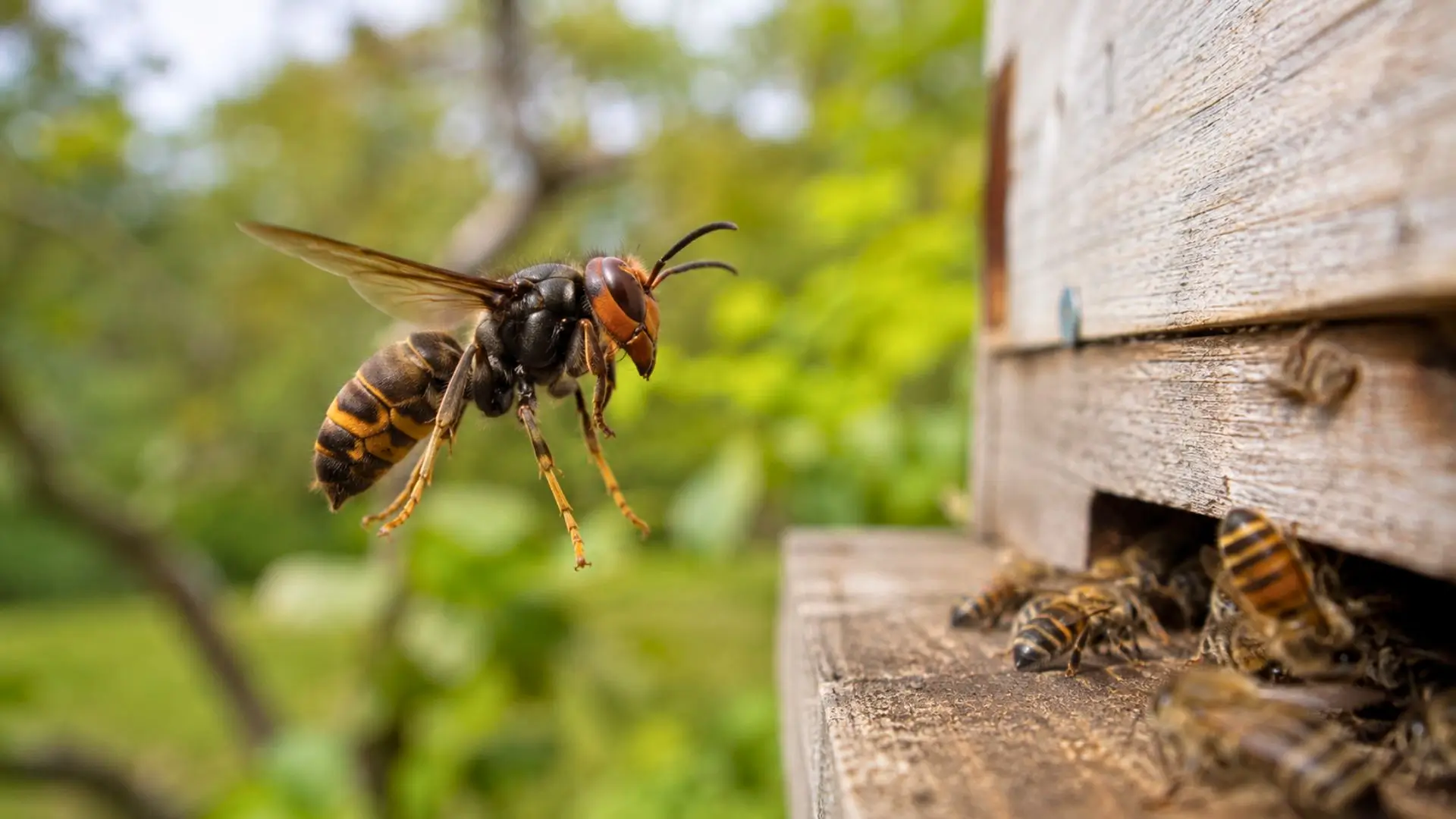
A single nest can block an entire beehive. The yellow-legged Asian hornet, now established across metropolitan France, has compelled the state, local authorities, and beekeepers to organize a sustained fight that blends nest destruction, selective trapping, and protections for apiaries.
How the Asian hornet went from an accidental introduction to a nationally monitored presence
The story begins in Lot-et-Garonne in 2004. The Ministry of Ecological Transition considered the hypothesis that a fertilized queen had arrived with goods from Asia. Twenty years later, all metropolitan departments report the presence of Vespa velutina nigrithorax.
This designation refers to the yellow-legged Asian hornet, an invasive exotic species. The term means that an animal introduced outside its native range establishes itself and disrupts local balances. In France, it finds prey, urban areas, hedgerows, and few specialized predators.
The speed of the phenomenon also hinges on its annual cycle. A queen starts a nest in spring, then the colony grows until the end of summer. The nest functions like a seasonal factory: the more worker hornets it produces, the more protein it provides to the larvae.
Why Asian hornet pressure can drain a hive even without a visible mass attack
In front of a beehive, the hornet does not hunt haphazardly. It hovers in stationary flight, grabs foragers as they return or depart, and then dissects them to feed its nest. This pressure reduces foraging activity, even when only a small number of bees are killed under the beekeeper’s eyes.
Foraging serves to bring nectar, pollen, and water. When the bees stay confined, the colony spends its stores instead of replenishing them. The effect is like a business that keeps its workers behind the curtain: the shop remains open, but the cash register is empty.
Why the cost of the Asian hornet exceeds honey and also impacts agricultural pollination
The ministerial briefing published in 2026 indicates that domestic bees account for about 40% of the hornet’s diet. The rest includes other insects, among them flies, wasps, and wild pollinators. The issue thus quickly moves beyond the sole beekeeping sector.
Pollination refers to the transport of pollen that allows many plants to produce fruit and seeds. IPBES, the Intergovernmental Science-Policy Platform on Biodiversity and Ecosystem Services, estimates that more than three-quarters of global food crops depend at least in part on pollinating animals.
The National Beekeeping Union of France estimates that inaction costs society more than €100 million per year. This total includes hive losses, nest destructions, and weakened pollination. For a market gardener or orchardist, the hornet becomes an indirect agricultural risk.
What the national plan against the Asian hornet changes, and why its budget remains a topic of debate
In March 2026, Mathieu Lefèvre, the minister delegated to Ecological Transition, unveiled a national plan to combat the hornet. The framework stems from Law No. 2025-237 of March 14, 2025, and Decree No. 2025-1377, published in the Official Journal on December 30, 2025.
The plan funds training, local coordination, applied research, nest destructions, and protection of apiaries. Its announced budget stands at €3 million per year. In spring, selective trapping targets founding queens before the large summer nests form. A poorly chosen trap can capture other insects as well, hence the ministry and the National Museum of Natural History emphasize targeted devices.

Contact details
Address:
Farmers Forum,
36, Dominick Street,
Mullingar,
Co. Westmeath,
Ireland
Phone:
+353 (0)44 9310206
Or email us:
For technical issues please check out our FAQ's page or email - [email protected]
For general Queries email - [email protected]
Request to add event to our Calendar - [email protected]
Send us your mart reports - [email protected]
Suggestions and feedbacks - [email protected]
News Items / Press Release - [email protected]
To Advertise on Farmers Forum - [email protected]