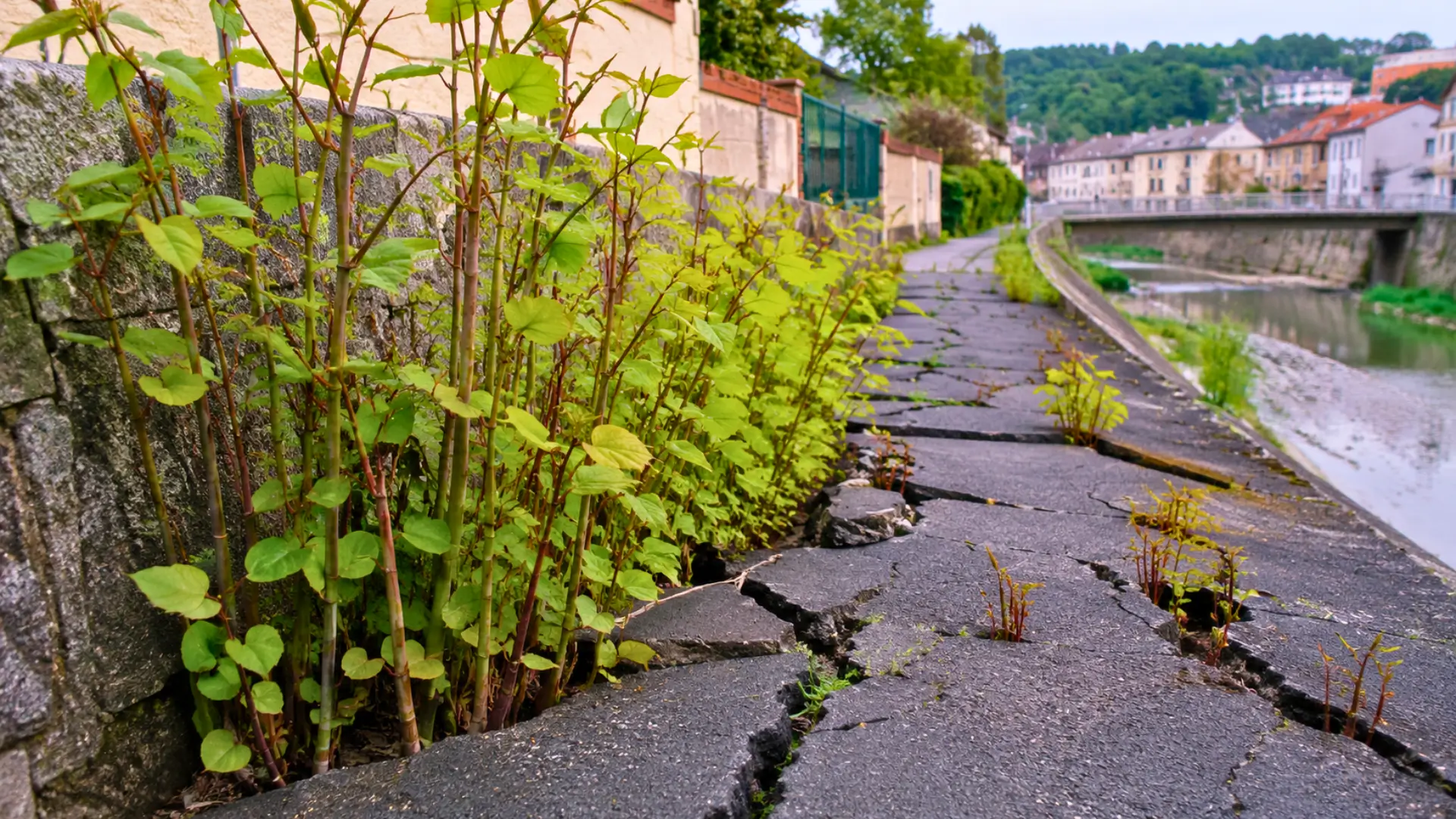
It grows faster than bamboo, pierces asphalt, and can survive for years underground. Once marketed as a decorative plant, Japanese knotweed is now banned in the European Union. Behind this decision lies a blend of ecology and unusual gastronomy.
How Japanese Knotweed Silently Destroys Roads, Gardens, and Foundations
In the 19th century, European botanists brought in the Japanese knotweed for its ornamental appeal. Yet the plant soon proved far from harmless. Its broad, elegant leaves and bamboo-like stems captivated botanists. Alarm bells quickly rang out. In some gardens, the plant advanced by several meters in a single season, swallowing fences and entire beds.
In 2022, researchers at INRAE observed an even more spectacular phenomenon. The plant’s roots can exert up to 50 tonnes of pressure per square meter, enough to crack a pavement or undermine foundations. Underground, its rhizomes can extend two meters deep and spread far beyond the visible zone.
The most troubling aspect remains its survival capacity. A simple rhizome fragment weighing ten grams is enough to recolonize an entire plot. A clump of soil displaced after construction, a stem forgotten in a ditch, or an involuntary transport can trigger a new invasion several years later.
Why the European Union Has Banned Japanese Knotweed Since 2025
As of August 7, 2025, the European Union officially lists Japanese knotweed among the invasive exotic species of concern. This decision bans its sale, transport, and planting throughout the EU. For local authorities, the move signals a turning point after years of often ineffective battles.
In some French municipalities, local authorities are already spending thousands of euros to eradicate just a few tens of square meters of contaminated land. Riverbanks are particularly vulnerable. When the stems die in winter, they leave the soils bare and fragile, promoting erosion and flooding during heavy rains.
Moreover, the issue is becoming legal as well. In the United Kingdom, property owners must declare the presence of the plant when selling a property. In France, several recent court decisions now discuss civil liability when knotweed spreads to neighboring lands or protected areas.
Young Knotweed Shoots Are Still Gathered and Cooked in Spring
Yet every year, between March and May, a small number of enthusiasts harvest the young shoots of knotweed. Plucked very early, before they become fibrous, they develop a tart flavor reminiscent of wild rhubarb. In some kitchens, they even end up in pies, compotes, or jams. This discreet tradition intrigues as much as it surprises.
In Japan, where the plant is known as itadori, locals sometimes salt the young stems and press them under a stone in a preparation akin to lacto-fermentation. Yet some ecologists warn that this famous “gastric eradication” remains symbolic. Even harvested regularly, the plant produces a biomass well beyond what harvesters can remove every spring.
Behind This Invasive Plant, a Compound Studied by Biologists Worldwide
Japanese knotweed hides yet another surprise. It is regarded as one of the richest plant sources of resveratrol, a molecule also found in grapes and red wine. Since the 1990s, this substance has drawn the attention of biologists for its studied roles in cellular aging and certain inflammatory diseases.
Furthermore, this chemical richness now fuels a real industry. In China, several thousand tons of rhizomes are processed each year to produce dietary supplements for the global market. The plant, which costs European authorities millions of euros in eradication efforts, becomes elsewhere a valuable economic resource. A delicate question remains for wild foragers.
The knotweed often grows on disturbed soils, near former industrial wastelands, alongside roads, or on contaminated ground. Indeed, this species readily absorbs certain heavy metals. Behind its tart young shoots and its remarkable resilience, the plant continues to blur the boundaries between ecological threat, culinary curiosity, and scientific resource.

Contact details
Address:
Farmers Forum,
36, Dominick Street,
Mullingar,
Co. Westmeath,
Ireland
Phone:
+353 (0)44 9310206
Or email us:
For technical issues please check out our FAQ's page or email - [email protected]
For general Queries email - [email protected]
Request to add event to our Calendar - [email protected]
Send us your mart reports - [email protected]
Suggestions and feedbacks - [email protected]
News Items / Press Release - [email protected]
To Advertise on Farmers Forum - [email protected]