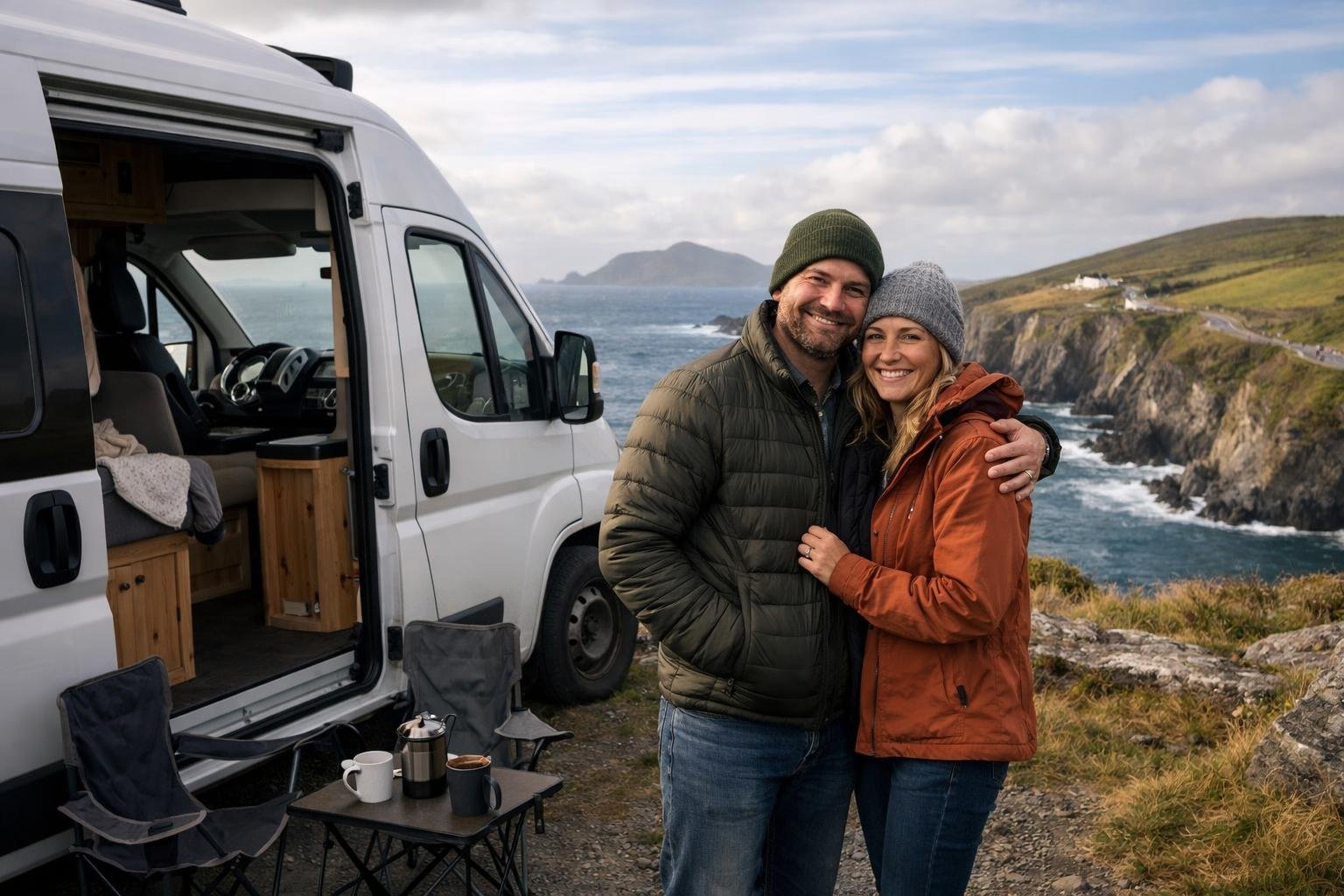
They were tired of weekends evaporating and of a life that felt overplanned. One evening, over a late supper, they decided to sell the house, buy a camper, and trace Ireland’s edges until the seasons told them to stop. “We wanted less, not more,” said Aisling, “and we wanted home to be wherever the kettle boiled.”
Why they chose the long road
The decision wasn’t born of burnout, but of a quiet ache for wonder. “We didn’t want a gap, we wanted a life,” Tom explained, steering their big white van onto a boreen, hedges brushing the mirrors like violin bows.
They imagined a year, then let time stretch, surrendering to tides and weather. “Ireland felt huge when we finally drove it slow,” Aisling said, “as if every bend had memory.”
The van that let them linger
They bought a used Ducato, named her Maggie, and taught her to sip sunshine through solar panels. Inside, they built a tiny home: drawer latches that clicked like manners, a cedar ceiling that smelled like rain.
A diesel heater kept winter wind at bay, and a small compost loo kept them unafraid of long, empty lanes. “Nothing felt sacrificial,” Tom smiled, “it just felt enough.”
Routes written by weather
They followed skylarks more than schedules, hugging the Wild Atlantic Way as storms hoisted their grey flags. In Donegal, cliffs cut the sky, and sheep drifted like clouds across the road.
Kerry gave them light that seemed painted, and Connemara gave them silence that hummed. “We learned the grammar of tides and the punctuation of rain,” Aisling said.
Making room for the small
Mornings began with a two-cup ritual, steam foxing the windows while gulls petitioned the shore. They learned to watch kelp for currents and crows for news.
Afternoons were for one cove, not ten; one lane, not thirty. “If you walk slow, the island walks with you,” Tom said, shrugging into a salt-stiff jacket.
People of the lay-by
Community arrived like tide, never on the calendar. A farmer in Mayo lent them a socket, pointed them toward a spring “sweet as Sunday,” and sent them off with eggs wrapped in paper.
At a pier in Clare, a fiddler tuned beneath a lamp, and strangers sang a chorus nobody owned. “We kept meeting guides when we didn’t know we were lost,” Aisling said.
Work that fits in a glovebox
They freelanced in small, quiet bursts: copy in the mornings, photos in the blue hours. Signal bars became currency, and cafés, once destinations, became offices that smelled of butter and newsprint.
Budgets held because their big spends were diesel and doughnuts, with campsites stitched between free park-ups. “Our fear of money was louder than the math,” Tom admitted.
Etiquette of the verge
They practiced Leave No Trace with near-religious care, picking litter that wasn’t theirs and refusing to camp where grass still remembered a wheel.
“Wild doesn’t mean thoughtless,” Aisling said, sliding a bag of rubbish into a bin. They learned that every perfect view already belongs to someone.
Hard days on soft ground
Rain infiltrated a roof vent, soaking a book of borrowed poems. Condensation slicked the windows, turning mornings into small weather systems.
There were midges that colonized their ankles, and a clutch that failed in a village at dusk. “We cried in the breakdown, then laughed at the tea that fixed nothing and saved everything,” Tom said.
Moments they keep like shells
Not the grand, postcard frames, but the weird, tender increments: a fox balancing on a wall of winter, the yellow square of light from a pub door.
A December swim that burned then blessed, and a January sunrise that arrived like a quiet apology. “The ordinary went gold, constantly,” Aisling said.
- Favorite places they whisper about still: the empty strand at Machaire Rabhartaigh, a rain-streaked lay-by on the Beara, and a woody valley in Wicklow where the kettle learnt a new song.
What changed without noise
They packed fewer anxieties and more spare socks, discovering that comfort is a moving target. Possessions felt like verbs, not nouns, chosen to do things rather than be things.
“Home became the table, two mugs, and a map that never sat still,” Tom said, folding the creases like ritual.
Eighteen months later
They rolled back to family, sun-faded and unhurried, and parked outside for a night that turned into three. The house they once owned now belonged to strangers, but the roads felt privately theirs.
“People ask if we have any regrets,” Aisling said, closing Maggie’s door with a gentle click. “Only that we didn’t learn to live smaller, sooner—and that we can’t learn it for you.”

Contact details
Address:
Farmers Forum,
36, Dominick Street,
Mullingar,
Co. Westmeath,
Ireland
Phone:
+353 (0)44 9310206
Or email us:
For technical issues please check out our FAQ's page or email - [email protected]
For general Queries email - [email protected]
Request to add event to our Calendar - [email protected]
Send us your mart reports - [email protected]
Suggestions and feedbacks - [email protected]
News Items / Press Release - [email protected]
To Advertise on Farmers Forum - [email protected]