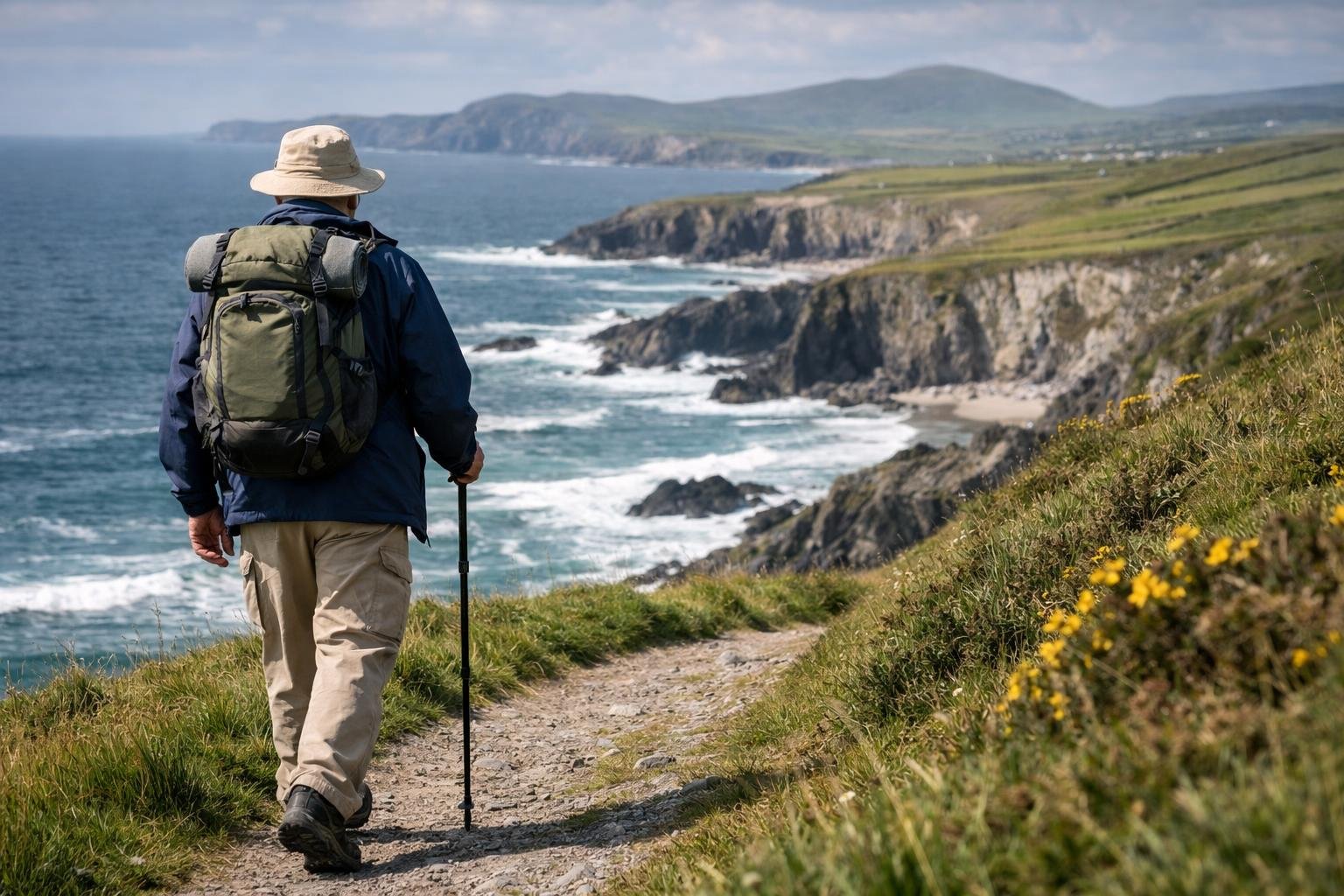
The salt hangs light in the air as he steps off another headland, counting waves instead of miles. At eighty-two, Michael Byrne moves with a careful economy, shoulders squared to the wind, eyes bright under the brim of a faded cap.
“I like to set off before the gulls wake,” he says, zip tugged to his chin. “You meet the day before it hurries, and it treats you a touch more kindly.”
He walks alone, but never lonely. The western edge offers a chorus—skylarks, surf, and the lowing of distant cattle—and he answers with quiet steps, one small rhythm in a long, echoing song.
The pull of the western edge
He had promised himself this coast on a winter afternoon, when the kettle hissed and the map lay open like a dare. The idea seemed both outrageous and obvious, the kind that stays in your pocket until it burns a neat little hole.
“It’s not a race, and never a conquest,” he says. “A coast doesn’t get conquered. You just share the day with it, if it lets you.”
He breaks the route into humane mouthfuls, hitching his nights to B&Bs and small-town pubs, measuring progress by cliff-top crosses, pier-side statues, and the smell of seaweed drying on smooth stone.
Why May gives you grace
When asked about timing, he doesn’t hesitate. “May is gentle,” he says. “The weather still has manners, the light lingers, and the hedges turn extravagant with gorse.”
The month matters in quiet, practical ways. The roads breathe before peak traffic. Trails feel newly combed, not yet trampled. Rain visits like a stern aunt, brief and opinionated, then gone.
“You get mornings with silver light, afternoons with a soft heat, and evenings that seem to apologize for ending,” he adds.
A solitary line, threaded through places
He walks, and places rearrange him. A pier where boys fish with short lines. A cemetery facing the sea with unblinking courage. A diner where a woman slides him extra bread because he reminds her of her uncle.
“The talk you need finds you,” he says. “Sometimes it’s a nod, sometimes a story, sometimes a dog deciding your boot needs supervision.”
He refuses the romance of hardship. Blisters are just blisters. Wind is just wind. Meaning settles in the small and ordinary, like sand inside a shell making its quiet pearl.
What keeps the feet honest
He favors light layers, a stick that knows his stride, and boots with miles of old arguments already solved. Lunch is a stubborn ritual: cheese, apple, small square of dark chocolate, and a thermos of bossy, black tea.
For those curious, he keeps his kit plain:
- A good map and a charged phone, a whistle in the chest pocket, water he drinks before he needs it.
“I call my daughter most evenings,” he says. “Not to be brave, just to be sensible. She tells me the forecast; I pretend I don’t already know.”
He has learned to sit early, not late, and to stop while the day still smiles. “Fatigue turns decisions into little liars,” he says. “Better to arrive with a small hunger than big regrets.”
Weather as a teacher, not a test
The Atlantic is a stern, beautiful tutor. Clouds herd across the sky like sheep with ideas. Sun flecks the water like coin tosses. A shower strafes the coast in needling silver, then folds into a shy blue.
“When a gust hits, I plant the stick and breathe,” he says. “You learn not to argue with air. You lean, then you listen.”
He has made friends with the forecast, but not a fetish of it. “Predictions are polite suggestions,” he adds. “The day writes its own postcard.”
Age is a measure, not a verdict
When strangers fuss over his years, he shrugs with a patient smile. “I’m not running from the number,” he says. “I’m walking with it. We keep a pace we both can hold.”
He trains by walking to the shop, by choosing stairs, by carrying a small weight while the kettle boils. Nothing dramatic, everything deliberate.
“The body answers to attention,” he says. “Give it a little respect, and it will give you a long, good day.”
What the road offers, if you let it
He talks about conversations with stone, about fences holding back nothing but habit, about birds stitching a coast back together after a gale has unpicked its seams.
“I wanted proof that I still notice,” he says. “Walking is the plainest kind of notice. Step, breath, glance, and then the small astonishments gather.”
On the longest days he counts to fifty, then starts again, a metronome for patience. On the hardest climbs he tells the hill, “I am stubborn,” and the hill replies, “So am I,” and they compromise near the top.
In the evenings, he sands down the day with a short note in a pocket book. Distance, weather, one thing he hadn’t expected to feel. “Gratitude is a strong wool,” he writes. “It keeps out the meaner winds.”
He doesn’t know if he’ll walk every mile, and it doesn’t bother him. “Some journeys are meant to be finished,” he says, “and some are meant to be inhabited. I’m satisfied with either.”
Tomorrow at dawn he will shoulder his small pack, wave to the sleepy windows, and set his boots toward the muttering edge. The path will meet him with its usual terms—pay attention, take your time, leave no noisy footprint—and he will agree, as always, with a quiet, stubborn yes.

Contact details
Address:
Farmers Forum,
36, Dominick Street,
Mullingar,
Co. Westmeath,
Ireland
Phone:
+353 (0)44 9310206
Or email us:
For technical issues please check out our FAQ's page or email - [email protected]
For general Queries email - [email protected]
Request to add event to our Calendar - [email protected]
Send us your mart reports - [email protected]
Suggestions and feedbacks - [email protected]
News Items / Press Release - [email protected]
To Advertise on Farmers Forum - [email protected]