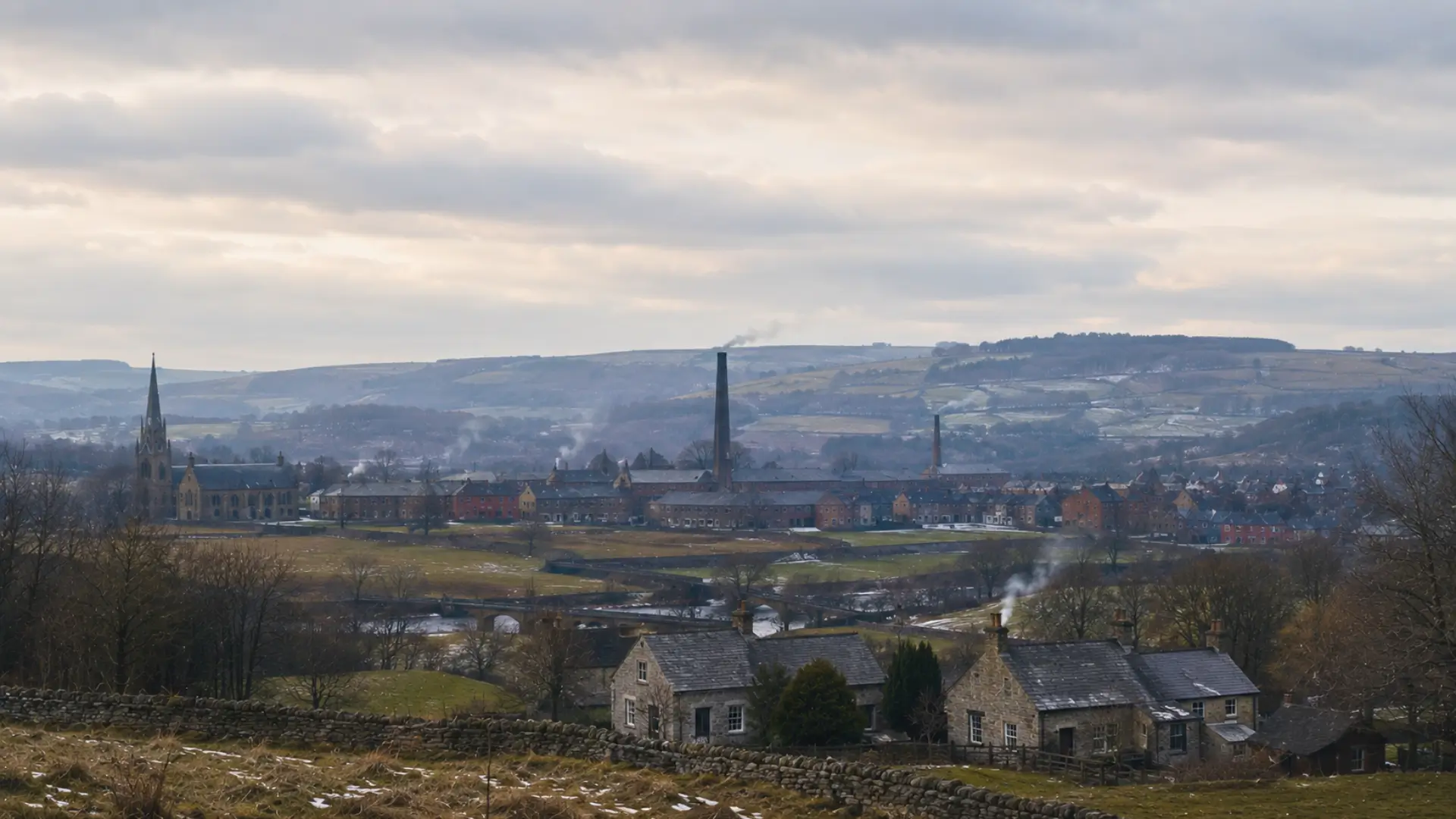
What if the air before factories had never been as clean as people think? A recent study on clouds over the United Kingdom and the southeastern United States upends a long-held climate certainty, with a troubling idea: the smoky past could distort today’s projections.
Clouds less dense today than at the start of the industrial era
In the traditional climate narrative, the matter seemed nearly settled: human activities have injected particles into the air, making many clouds denser and more reflective. Yet a study published in Geophysical Research Letters paints a far stranger scene. Over two regions that have been studied extensively, today’s clouds would contain fewer droplets than they did in 1850.
The phenomenon concerns the southeast United States and the United Kingdom, two areas long thought to fit neatly into the grand industrial narrative. Researchers from the University of Wyoming and the Pacific Northwest National Laboratory tested this anomaly with more than 500 simulations. It reappears almost every time, like a stubborn clue that refuses to disappear.
Wood and coal smoke had already transformed the atmosphere by 1850
The caveat arises from a too-smooth image of the past. The year 1850 is often used as a preindustrial benchmark, but it does not correspond to a planet that was pristine, silent, and lucid. In many regions, people burned wood to heat, cook, clear land, produce, and survive. These ordinary acts were already sending aerosols into the atmosphere.
In the American Southeast, this footprint was particularly pronounced. Settlers pushed through dense forests, opened farmland, and relied heavily on biofuels. According to the researchers, the region was among the highest per capita wood consumers at the time. The winter air thus became laden with particles capable of feeding cloud formation.
The United Kingdom followed a different route—more urban, more mineral, but just as troubling. Coal was permeating cities, workshops, transport, and homes. In winter, when the atmosphere naturally lacks condensation nuclei, these fumes could drastically alter droplet size and quantity. The sky thus bore the trace of a nascent modernity.
These tiny droplets that can alter the balance of the global climate
A cloud is not merely a white mass decorating the sky. Its structure influences how much solar light is reflected back into space. The more numerous and smaller the droplets, the more reflective the cloud becomes. This microscopic detail can therefore produce a measurable climatic effect, sometimes strong enough to tilt the balance between warming and cooling.
This is why climatologists are so intrigued by the discovery. If 1850 emissions were underestimated, the contrast between past and present changes. Some calculations of aerosol cooling could be revised. An imperfect historical reference risks shifting the entire interpretation of clouds’ role in the modern climate.
The choice of 1850 as the preindustrial reference is becoming increasingly fragile
The CMIP6 protocol, used in many international models, still takes 1850 as the starting preindustrial point. Yet this date comes after centuries of fires, agricultural practices, domestic heating, and early industrial pollution. It resembles less a blank page than a palimpsest, already covered with invisible traces.
The doubt grows also thanks to other natural archives. Ice cores and sediments suggest that ancient biomass-burning may have been two to four times more intense than some inventories indicate. In other words, the preindustrial atmosphere could have been far more laden than models assume.
The authors remain cautious: the study rests on a single model, E3SMv3, and it will need to be confronted with other simulations. But the message is already powerful. To better forecast the future, we may first need to reopen the dossier of the past—the history of chimneys, burned forests, and clouds we believed quiet.

Contact details
Address:
Farmers Forum,
36, Dominick Street,
Mullingar,
Co. Westmeath,
Ireland
Phone:
+353 (0)44 9310206
Or email us:
For technical issues please check out our FAQ's page or email - [email protected]
For general Queries email - [email protected]
Request to add event to our Calendar - [email protected]
Send us your mart reports - [email protected]
Suggestions and feedbacks - [email protected]
News Items / Press Release - [email protected]
To Advertise on Farmers Forum - [email protected]