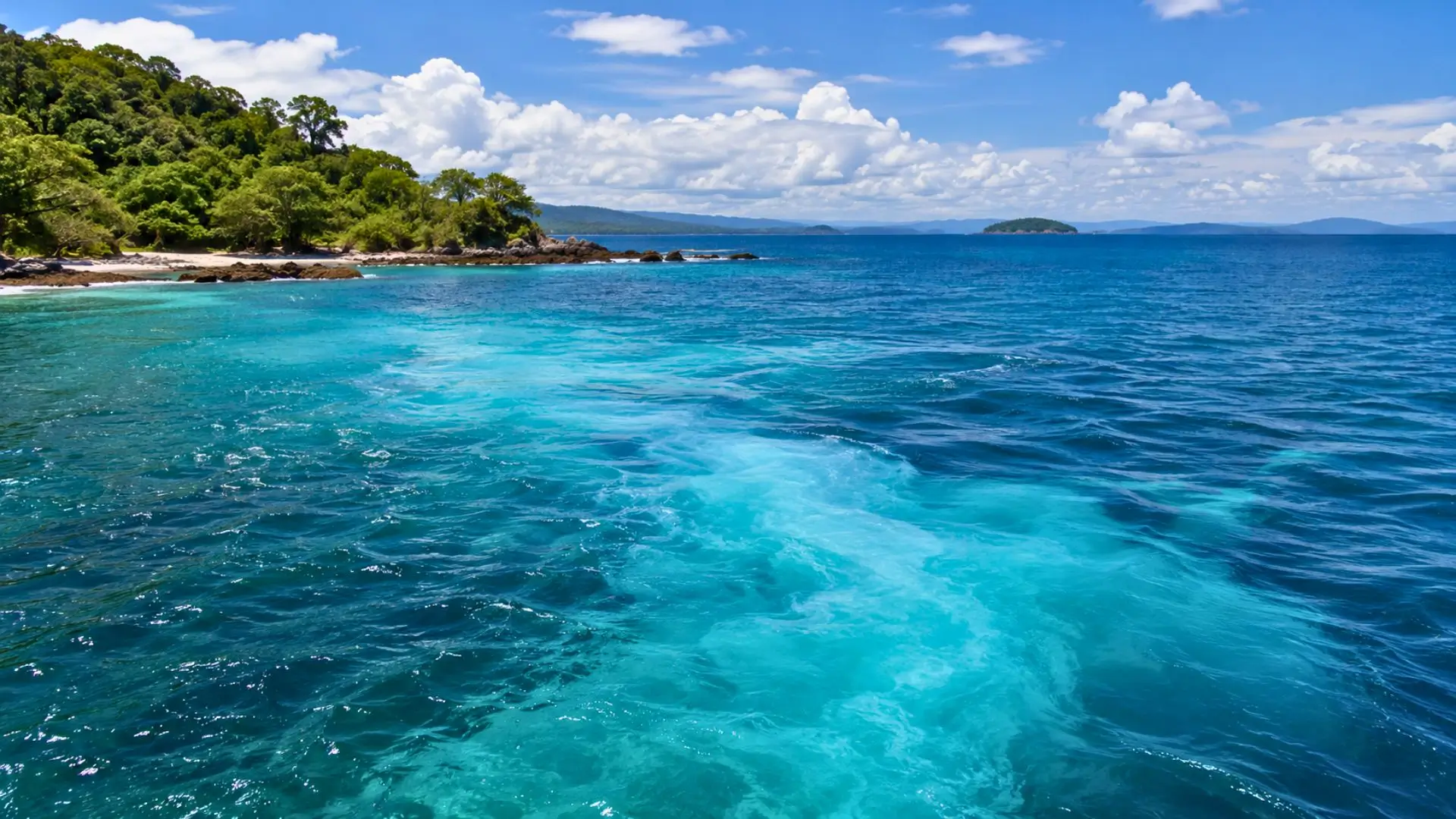
Cold water did not rise at the right moment. In the Gulf of Panama, this seasonal meeting normally feeds an entire marine chain. Its failure in 2025 highlighted a subtle mechanism, tracked by researchers and vital for fishermen.
A Marine Cycle Researchers Had Been Tracking Like a Clock for Forty Years
In the Gulf of Panama, the resurgence denotes the upward movement of deep waters toward the surface. These cold waters carry nitrates and phosphates, two nutrients comparable to a natural fertilizer. Between January and April, this marine engine feeds phytoplankton, the base of the food chain.
The Smithsonian Tropical Research Institute, based in Panama, has followed this phenomenon since 1985. The Aaron O’Dea team published in PNAS a clear finding: in 2025, the usual cooling and peak in productivity barely occurred. The visible green of the phytoplankton remained weak.
The rupture is also evident in the measurements. According to the University of Warsaw, associated with the work, the resurgence arrived with more than six weeks of delay, lasted only 12 days compared with 66 days on average, and descended only to 23.3 °C, far from the historical 14.9 °C.
Too-Weak Trade Winds Prevented the Natural Pump from Activating
The mechanism depends on a simple atmospheric gesture. The northern trade winds push the surface warm water toward the open ocean. The cold water then rises to fill the void, like a spill that is pulled and drags the fabric below.
In 2025, wind episodes were too short and too infrequent. The Intertropical Convergence Zone, a mobile band where winds meet near the equator, would have stayed too far north during La Niña 2024-2025. Researchers remain cautious, because the precise link still requires more measurements.
Fisheries, Coral Reefs, and Beaches: What a Warmer Sea Changes
The failure involves more than just a scientific chart. Phytoplankton subsequently nourishes sardines, anchovies, tuna, shrimp, and seabirds. When the base is missing, the ripple effect can rise up through the entire chain, from the fishing nets to the coastal market.
Corals also lose a thermal ally. In the Panamanian Pacific, deep water typically cools the coastline during the dry season. Without this cold cushion, reefs endure warmer water for longer, increasing the risk of bleaching when corals expel their partner algae.
The economic stake explains the fishermen’s attention. The study notes that more than 95 % of Panama’s marine biomass comes from the Pacific and that fishing exports weigh in at around $200 million per year. A weak season can therefore weigh on entire villages.
The 2026 Monitoring Will Say Whether the Alert Was a One-Off or More Lasting
The 2026 measurements already bring an important nuance. The Aaron O’Dea laboratory tracks the thermocline, the boundary between surface warm water and deep cold water. In early February, it rose toward the surface and waters at 16 °C were reported in some areas.
The monitoring updated on April 21, 2026 subsequently indicates a gradual weakening, with a cold layer beginning to descend but surface waters still cool. This alternation shows why researchers are calling for more buoys, sensors, and direct measurements in tropical resurgences.

Contact details
Address:
Farmers Forum,
36, Dominick Street,
Mullingar,
Co. Westmeath,
Ireland
Phone:
+353 (0)44 9310206
Or email us:
For technical issues please check out our FAQ's page or email - [email protected]
For general Queries email - [email protected]
Request to add event to our Calendar - [email protected]
Send us your mart reports - [email protected]
Suggestions and feedbacks - [email protected]
News Items / Press Release - [email protected]
To Advertise on Farmers Forum - [email protected]