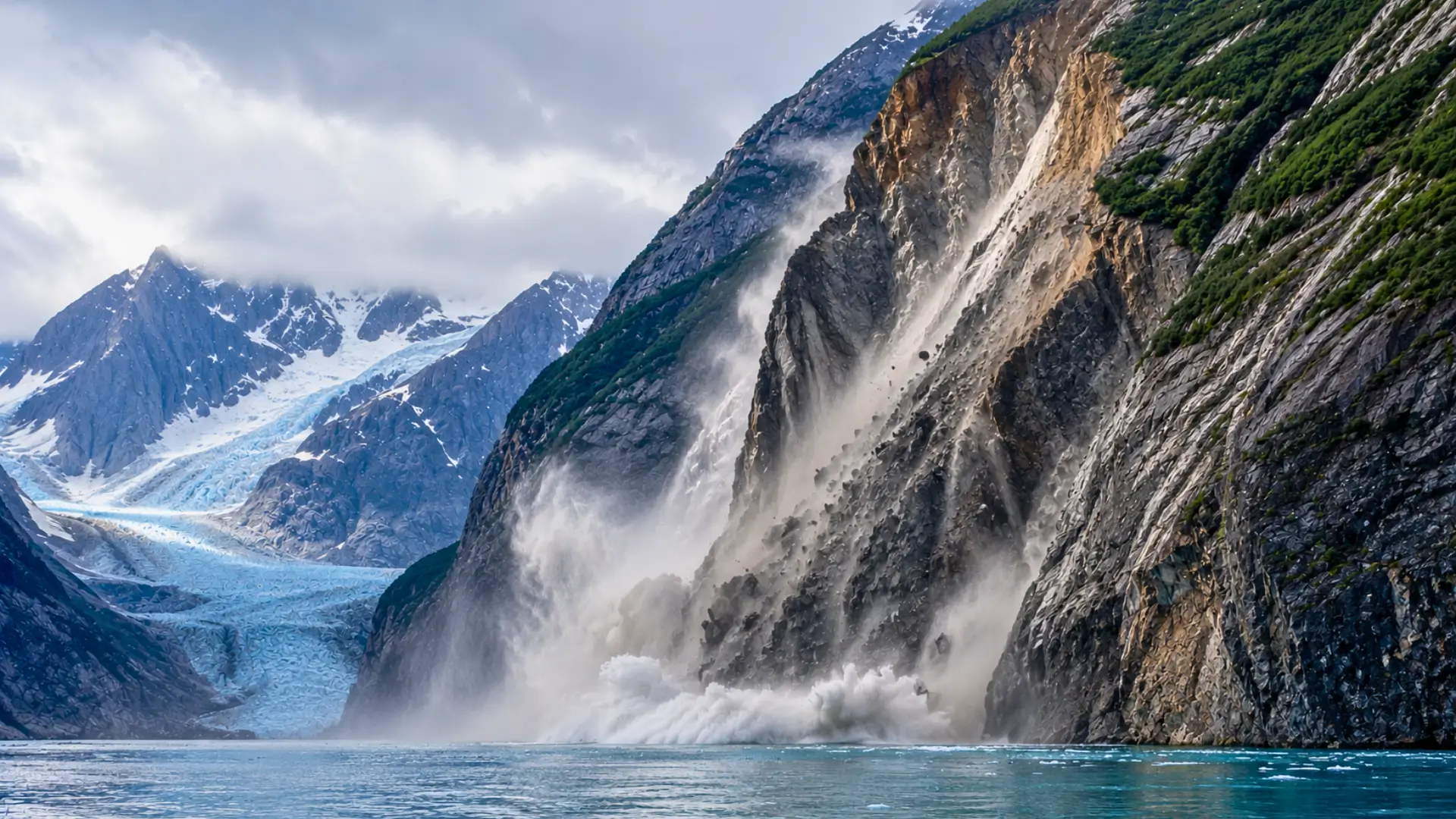
In August 2025, a colossal collapse struck an Alaska fjord a few hours after the passage of a cruise ship. The giant wave that followed pulverized the surrounding cliffs, revealing a growing danger directly linked to the accelerated melting of polar glaciers.
A colossal collapse triggers a 481-meter wave in an Alaska fjord
On August 9, 2025, Barry Arm Fjord seemed to remain frozen in an almost unreal calm. A few Hanse Explorer tourists photographed the blue reflections of the South Sawyer glacier. Nobody imagined a geological disaster brewing behind the mountains. A few hours later, the scene became unrecognizable under the impact of a titanic landslide.
Millions of tons of rock violently detached from a destabilized slope before plunging into the icy water. The impact generated phenomenal energy. The ocean was hurled up to 481 meters onto the opposite cliff. This measurement corresponds to the maximum run-up, the height reached by the water after impact.
The scene recalls the great natural disasters depicted in cinema. Yet, no special effects were necessary. Geologists observed swaths of vegetation ripped away. The rock appeared bare, as if decapitated by an explosion. In some places, the wave surpassed the height of the Taipei 101.
Glacier melt is now weakening the mountains that border the fjords
For thousands of years, glaciers played a crucial role in the balance of Arctic fjords. These ice masses served as natural supports for neighboring mountains. Today, with the accelerated warming of the oceans, this invisible structure is slowly collapsing.
In Greenland, Norway, and Alaska, scientists now observe water-saturated cliffs. Many have lost their glacial support. When ice retreats rapidly, the pressure exerted on the rocks changes abruptly. The ground then fractures slowly before giving way without obvious warning.
The researchers now speak of “glacial decompression.” This phenomenon remains little known to the general public. Yet it already forms part of the new major climate risks. Each hotter summer increases water infiltration and weakens entire landforms. In some isolated fjords, geological maps become almost obsolete.
Seismic signals revealed the collapse long before the catastrophe
Seismologists are not only concerned with the size of the tsunami. They also study signals that appeared before the disaster. According to a study published in the journal Science, the mountain would have produced thousands of small vibrations before its final collapse. These microseisms formed a geological language still difficult to interpret.
Sensors installed in the region recorded a phenomenon called “continuous tremor.” Unlike a conventional earthquake, it is not a sudden shock. This permanent rumble stems from internal movements of the rock. For several specialists, this seismic buzz could help anticipate future catastrophes.
A three-level alert system could limit future mega-tsunamis
Facing these growing risks, several international teams propose an alert system inspired by those used for avalanches. It would also function like devices designed for volcanic eruptions. Heavy rainfall and rapid glacier retreat could trigger a yellow alert restricting access to the fjords.
If sensors detect continuous tremor or accelerated ground movements, an orange alert would enforce the evacuation of tourist boats. The red level would then signal an imminent rupture. In some scenarios, distant ships would have about ten minutes to position themselves to face the wave.
The stakes go far beyond Alaska. Polar tourism is booming and glaciers are melting even faster. These mega-tsunamis could therefore become less rare. The fjords still captivate with their silent beauty. Yet beneath this icy postcard lies an unstable mechanism that the planet is only beginning to understand.

Contact details
Address:
Farmers Forum,
36, Dominick Street,
Mullingar,
Co. Westmeath,
Ireland
Phone:
+353 (0)44 9310206
Or email us:
For technical issues please check out our FAQ's page or email - [email protected]
For general Queries email - [email protected]
Request to add event to our Calendar - [email protected]
Send us your mart reports - [email protected]
Suggestions and feedbacks - [email protected]
News Items / Press Release - [email protected]
To Advertise on Farmers Forum - [email protected]