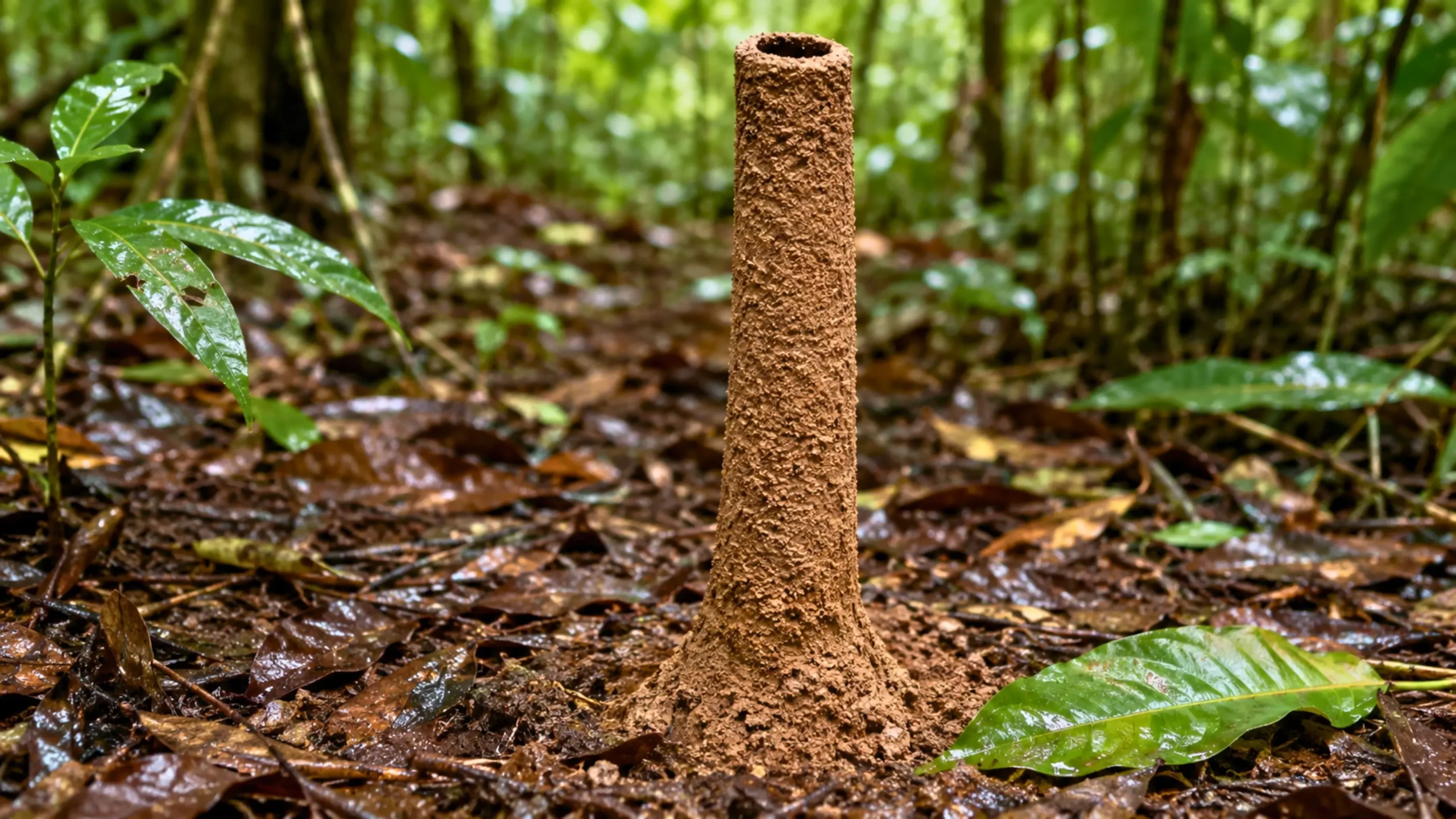
Forty latex condoms helped scientists understand Amazonian clay towers. In the cicada Guyalna chlorogena, a nymph—which is a juvenile stage before adulthood—shapes these tubes before metamorphosis. Their role combines respiration and protection, like a snorkel perched on a tiny fortress.
Why these clay chimneys built by cicada nymphs intrigue biologists so much
On the ground, these cylinders resemble small light-brown chimneys. The nymphs build them from clay mixed with their wastes, rising from an underground shaft that can lead to the roots. The tower then becomes a prolongement of the burrow, visible in the damp litter.
In Guyalna chlorogena, the structure is built during the late part of the juvenile life. Earlier work often described towers of 20 to 40 cm, i.e., the length of an elongated school ruler. The new study even reports a record of 47 cm.
This architecture intrigues because it far exceeds the size of the animal hidden beneath it. The nymph shapes a delicate structure, but tall enough to alter its contact with air and ground. At this scale, a column of mud becomes a biological tool.
How the height of these clay towers reduces risk when ants patrol the ground
The team led by Marina Méga, a PhD student in ecology at the Federal University of Rio de Janeiro, tested a simple idea. If the tower protects the nymph, the ants should reach it less often. Baits placed at the summit and on the ground served as comparable traps.
The result shows a clear gap: baits placed on the towers attracted eight times fewer ants than those placed nearby. For a metamorphosing nymph, that protective height acts like the edge of a table for a crumb surrounded by insects.
Why forty condoms allowed testing air flow without breaking the towers
The second hypothesis concerned respiration. Amazonian soils can stay saturated with water, which limits gas exchange, in other words the passage of oxygen and carbon dioxide. A hollow tower could function as an air vent above the mud.
To obstruct the opening without breaking the clay, the biologists used latex caps. The condoms offered a soft and airtight membrane, fitted to irregular shapes. This makeshift approach allowed testing air circulation without crushing the structures.
What this clay architecture reveals about the extended phenotype and the discreet strategies of insects
After obstruction, the nymphs did not rebuild all their towers in the same way. The larger structures responded differently than the smaller ones, a sign of a size-dependent reaction. The study mentions a height of the tower-dependent effect.
This behavior supports the idea of an extended phenotype, that is, a trait built outside the body but useful to the animal. Like a beaver dam altering a stream, the tower transforms the microclimate of the burrow around a hidden nymph.
Published in Biotropica in 2026, these results do not reduce the tower to a single function. It decreases encounters with ants and participates in gas exchange. In the forest near Manaus, a 47 cm column remains standing in the damp clay.

Contact details
Address:
Farmers Forum,
36, Dominick Street,
Mullingar,
Co. Westmeath,
Ireland
Phone:
+353 (0)44 9310206
Or email us:
For technical issues please check out our FAQ's page or email - [email protected]
For general Queries email - [email protected]
Request to add event to our Calendar - [email protected]
Send us your mart reports - [email protected]
Suggestions and feedbacks - [email protected]
News Items / Press Release - [email protected]
To Advertise on Farmers Forum - [email protected]