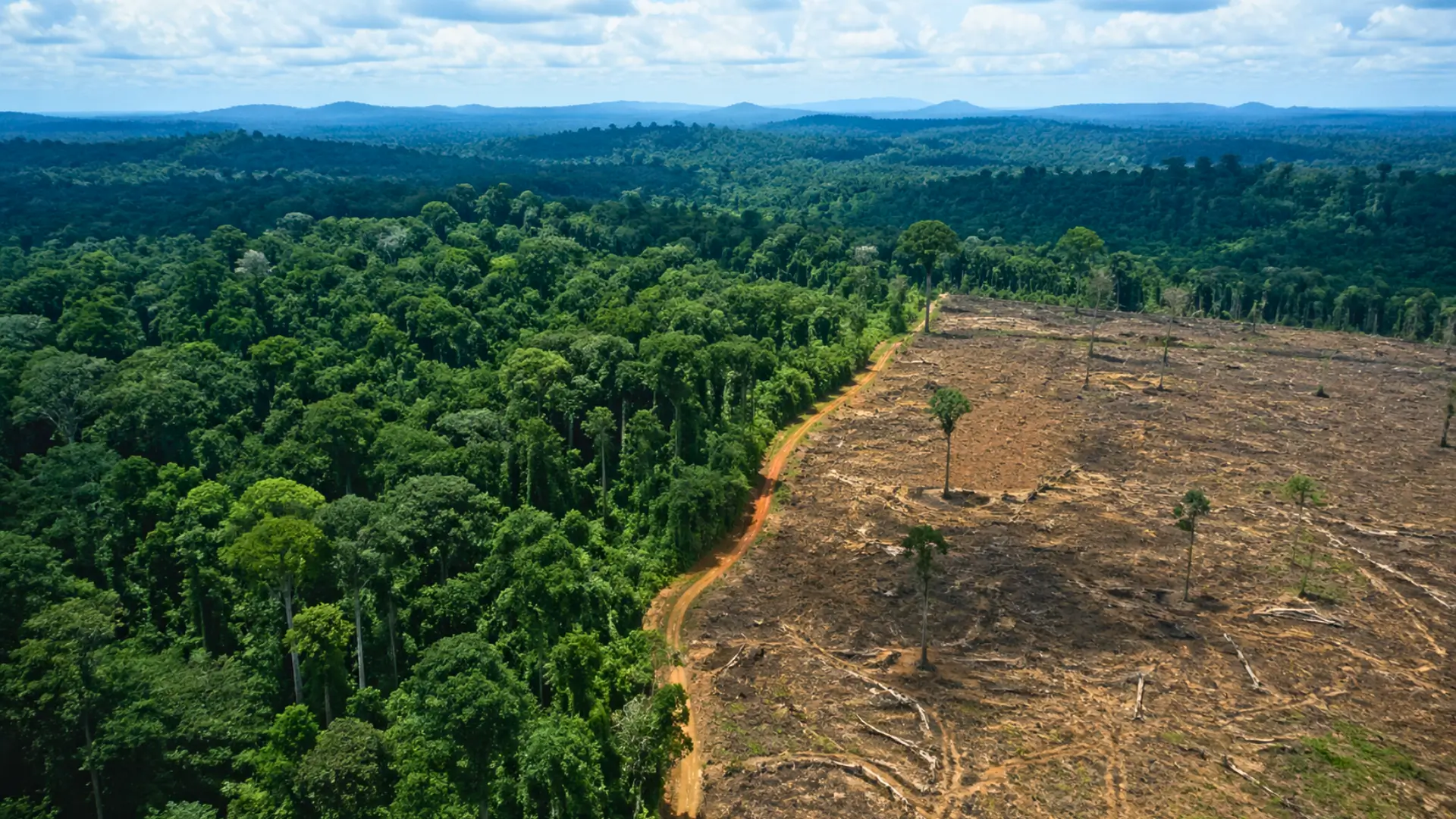
What if one of the planet’s greatest allies in the fight against climate change is disappearing before our very eyes? A recent study reveals an unexpected tipping point: African forests are no longer absorbing CO2 the way they once did. And this shift could upend everything.
2010 Marks the Turning Point: African Forests Shift from Carbon Sinks to Emission Sources
Until the early 2010s, African forests played a quiet but essential role: that of natural carbon sinks. Thus, they absorbed more CO2 than they released, helping to slow global warming. Yet this fragile mechanism reversed abruptly around 2010.
Between 2007 and 2010, forest biomass was still rising strongly. However, without a true global alert, the trend reversed. From 2010 onward, forests began to lose density, releasing carbon instead of storing it. This silent reversal thus marks a major rupture in the climate balance.
Moreover, researchers rely on robust data from NASA’s GEDI mission and from Japanese satellites. Thus, their conclusion is unequivocal: the transition is statistically certain. Indeed, this is not a transient variation, but a structural change that redefines the continent’s ecological role.
The Congo Forest Degrades Under Human Pressure and Loses Its Climate-Regulating Role
Long perceived as the “lungs of Africa,” the Congo Forest now embodies a troubling paradox. Indeed, this vast expanse, the second-largest tropical forest in the world, continues to absorb CO2, but less and less efficiently. Most notably, it now emits more CO2 than it captures.
Meanwhile, human pressure is intensifying. On one hand, agricultural expansion gnaws at the forest edges, while on the other, mining activity grows under the pressure of global metal demand. Moreover, charcoal production remains essential for many communities. Thus, this mix leads to a gradual degradation that is hard to detect with the naked eye.
As a result, in some regions the forest gives way to savanna. And these ecosystems do not store carbon in the same way. Indeed, a centennial tree stores far more carbon than a shrub. Consequently, this gradual replacement constitutes an invisible loss, but with heavy implications for the global climate.
A Major Scientific Shift Forcing a Rethink of Global Climate Models
For decades, the tropical forests were taught as unflinching allies of the climate. Yet this idea, once correct, no longer matches current reality. Thus, the observed tipping point requires a deep reevaluation of how we understand the role of ecosystems.
In practice, this shift has practical implications. Indeed, global climate strategies relied partly on forests’ capacity to absorb a share of human emissions. Consequently, if this natural buffer disappears, the efforts required to limit warming become far greater.
Furthermore, researchers from the universities of Leicester, Sheffield and Edinburgh emphasize that the Paris Agreement targets could become harder to reach. In short, what nature once absorbed will need to be offset in other ways. Thus, added pressure now bears down on international climate policies.
An Ecological Turning Point that Worsens Climate Inequality Across Regions
Hence, this turning point raises a troubling question. Sub-Saharan Africa emits very little CO2 from fossil fuels, yet finds itself at the heart of a phenomenon that exacerbates warming. Thus, this paradox highlights a climate inequality rarely voiced with such force.
Indeed, a large share of land-use emissions stems from essential needs: feeding, heating, surviving. Lacking alternatives, wood remains a central resource. Consequently, this context transforms a social constraint into a global environmental issue.

Contact details
Address:
Farmers Forum,
36, Dominick Street,
Mullingar,
Co. Westmeath,
Ireland
Phone:
+353 (0)44 9310206
Or email us:
For technical issues please check out our FAQ's page or email - [email protected]
For general Queries email - [email protected]
Request to add event to our Calendar - [email protected]
Send us your mart reports - [email protected]
Suggestions and feedbacks - [email protected]
News Items / Press Release - [email protected]
To Advertise on Farmers Forum - [email protected]