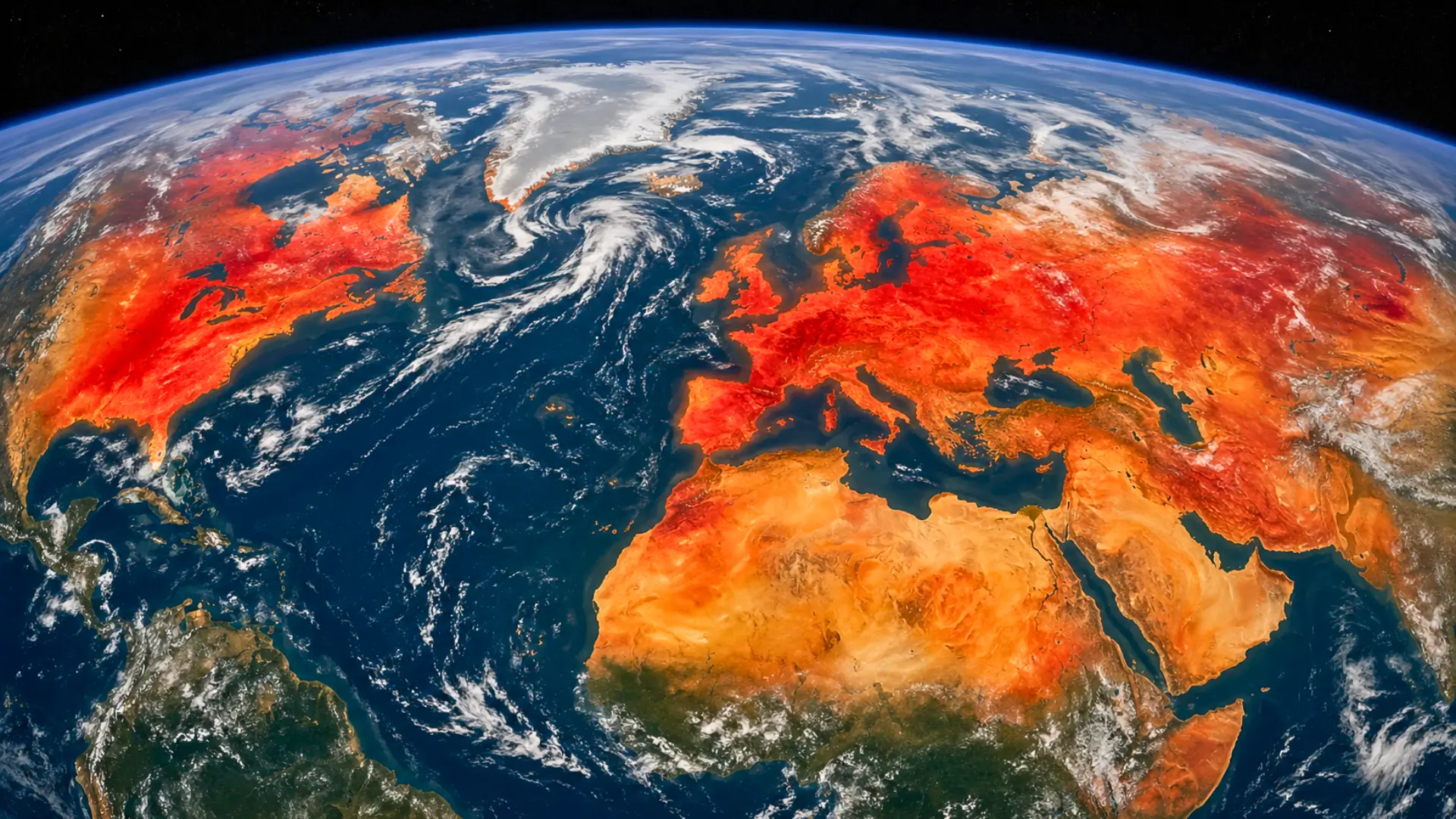
What if the summer of 2026 marks a visible turning point in the global climate? Between alarming projections and amplifying natural phenomena, the planet could experience an extraordinary season, where heat is no longer an exception but a new silent rule.
A Global Climate Map Dominated by Unprecedented and Widespread Heat Anomalies
Climate maps can sometimes appear abstract, almost distant. Yet the map recently released by the European Copernicus program stands out for its deep-red dominant hue, a symbol of abnormally high heat. For the summer of 2026, nearly 70 % of the globe would display this maximum signal.
This is not merely a trend. Behind these colors lies a near 100% probability of temperatures above normal seasonal averages. Western Europe, with France in particular, emerges as a major hot spot, but it is not alone in this global picture.
Even more troubling, about 90 % of the Earth’s surface is expected to experience thermal anomalies, even modest ones. The temperate zones, traditionally, would become testing grounds for climate experimentation, where historical reference points begin to waver.
El Niño’s Return Strongly Amplifies Global Climate Imbalances
In the waters of the equatorial Pacific, a well-known phenomenon among climate scientists is resurfacing. El Niño, often likened to a natural thermal accelerator, is poised to come into play as early as spring 2026, according to analyses by the World Meteorological Organization. When surface ocean temperatures rise, they profoundly alter atmospheric currents.
The result is more frequent heat waves, droughts in some regions, and extreme rainfall in others. The impact extends far beyond the Pacific. What concerns this year is the potential intensity of the phenomenon. Early data suggest a particularly strong episode, capable of amplifying the trends already observed over several years.
Historical CO₂ Levels That Sustainably Boost Global Warming
In parallel, another factor operates in the background, quieter but just as powerful. The concentration of carbon dioxide in the atmosphere has reached levels not seen in about 3 million years, according to several international scientific institutions.
This greenhouse gas, produced primarily by human activities, acts as an invisible blanket. It traps heat and prevents the planet from cooling naturally. Despite political and technological efforts, emissions continue to rise.
This buildup creates a climate favorable to extremes. When El Niño enters the scene in this context, the combined effect becomes explosive. It is this double climate pressure that makes the summer of 2026 particularly worrisome.
Extreme Heat Peaks Now Plausible Even in Temperate Regions
A few years ago, imagining temperatures reaching 50 °C in Europe would have been fiction. Today, that scenario is not entirely ruled out. Some climate simulations now point to peaks of extreme heat, even in regions historically temperate. And the consequences extend beyond the thermometer. Public health, agriculture, water resources, and infrastructure could be severely affected.
Prolonged heat waves test human systems as much as ecosystems. In light of these projections, a question gradually emerges. Is the summer of 2026 a remarkable anomaly or the beginning of a new climatic normal where each season pushes the known boundaries a little further?

Contact details
Address:
Farmers Forum,
36, Dominick Street,
Mullingar,
Co. Westmeath,
Ireland
Phone:
+353 (0)44 9310206
Or email us:
For technical issues please check out our FAQ's page or email - [email protected]
For general Queries email - [email protected]
Request to add event to our Calendar - [email protected]
Send us your mart reports - [email protected]
Suggestions and feedbacks - [email protected]
News Items / Press Release - [email protected]
To Advertise on Farmers Forum - [email protected]