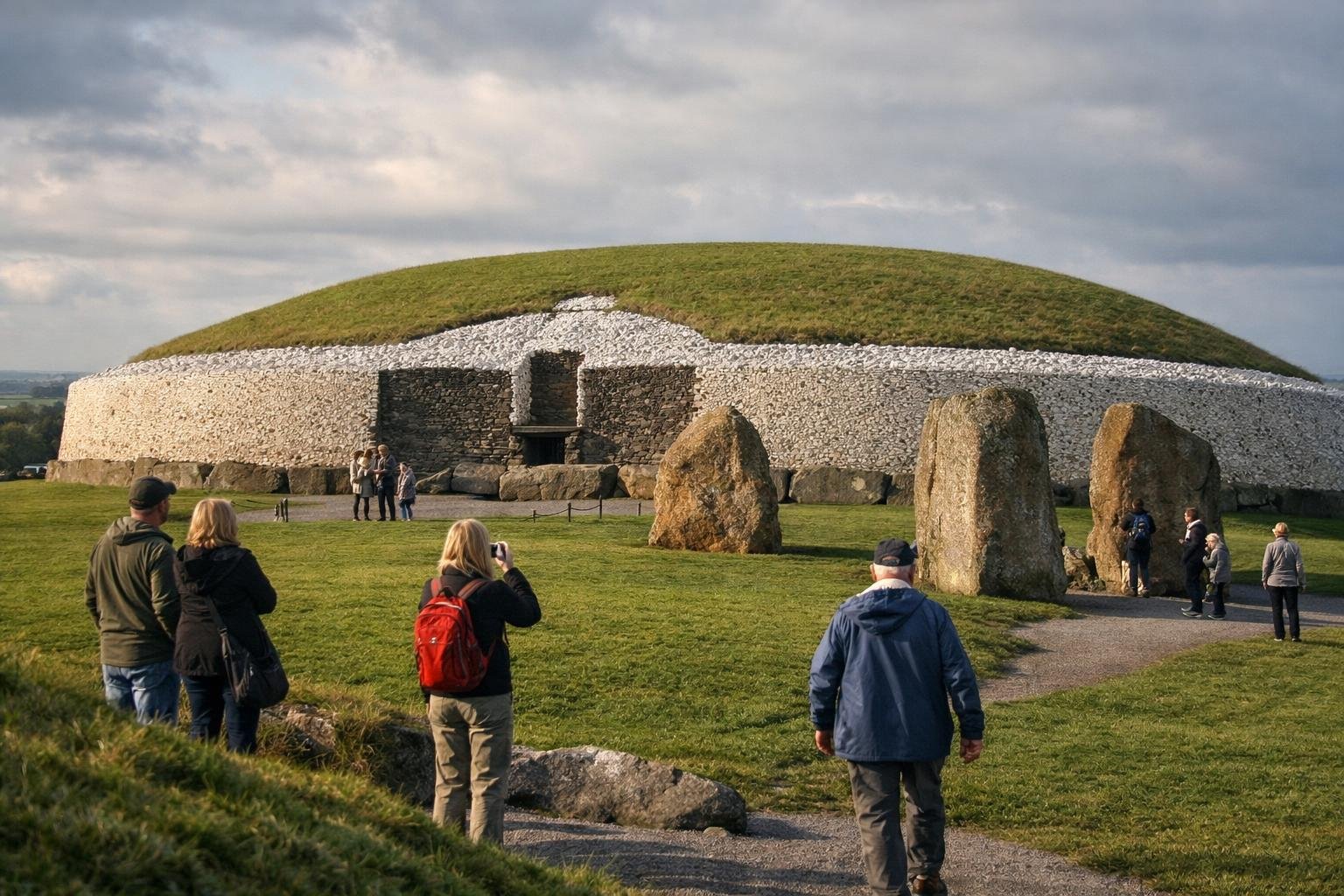
Mist rises over the Boyne Valley as a white arc of stone catches the first light. Travelers step from a shuttle, lower their voices, and look up at a monument that feels both familiar and alien. The air carries a cool, mineral scent, and the grass is wet with history. People come for answers and leave with questions, pockets full of silence and awe.
This vast, grass-crowned mound is called Newgrange, part of the Brú na Bóinne complex in County Meath. It sits within a loop of the river, wrapped by farmland and folklore. It’s a place where time folds, where the modern road ends and a Stone Age itinerary quietly begins.
A monument from the dawn of time
Archaeologists date the site to around 3200 BCE, which makes it older than the pyramids of Giza and earlier than the stones at Salisbury Plain. That fact lands with a gentle shock, like discovering your great-grandparents built a working observatory out of earth and rock. “They were engineers, artists, and astronomers rolled into one,” a guide murmurs as hands brush the air, careful never to touch the carvings.
The structure is a passage tomb, but “tomb” barely covers its purpose. A long, narrow corridor leads into a cruciform chamber, capped by a corbelled roof that has stayed watertight for five millennia. The stones are massive, many ferried from miles away, fitted without mortar, and locked together with prehistoric precision.
Walk the kerb and you find swirling symbols pecked into greywacke: spirals, lozenges, and the famous triple spiral on the entrance stone. Each line feels both decorative and deliberate, a message we can read with our eyes but not fully with our minds.
The solstice keyhole of light
Above the doorway sits a small aperture—the “roof box”—that turns darkness into theatre. For a few minutes around the winter solstice, a blade of sunlight slides through that slot and runs the length of the passage. It climbs the floor, reaches the central chamber, and sets the stones burning a patient, golden glow. Then it withdraws, like a secret rescued back by the year.
Witnessing this alignment is rare; access is limited, and local authorities run a lottery for the privilege. A simulated version during tours gives a hint: the lights drop, the hush grows thick, and a low bar of amber creeps in. “I felt my heartbeat slow to match the sun,” a visitor whispered, stepping out into the raw daylight.
The alignment is not accident, and that’s the staggering part. Someone, five thousand years ago, calculated angles, tracked seasons, and composed a ceremony of astronomy and stone. It suggests a calendar, a cosmos, and a community able to feed, organize, and imagine at scale.
Craft, art, and the living façade
The outer face glitters with white quartz, punctuated by dark granite cobbles. Debate swirls about how the façade originally looked, but the effect today is undeniably striking—a crescent that drinks light and throws it back. “It’s less a wall than a stage,” says another guide, “where the sky plays the lead.”
Inside, the corbelled roof rises like a stacked stone lantern, each layer leaning inward to lock the one above. Rain has tried and failed to cross it for thousands of years. Touch nothing, breathe softly, and you can hear your own footsteps folding into the room’s round acoustics.
Brú na Bóinne includes neighbors Knowth and Dowth, a constellation of passage monuments with their own alignments and art. Together they form a UNESCO World Heritage landscape inscribed since 1993, a campus of deep-time ingenuity beside the river that feeds it.
Before you go
- Book via the Brú na Bóinne Visitor Centre at Donore; timed tickets and shuttles control numbers. Aim for early mornings, bring layers for Irish weather, and respect the stones—no touching, no flash, and listen to the rangers who keep the place safe.
Myth in the grass
Local lore threads the site to the Tuatha Dé Danann, to the Dagda and his son Óengus, to hidden music and time that stops and starts again. Myth, here, feels less like fantasy and more like a language for the unmeasurable. “It’s where science and story shake hands,” a ranger says, pointing toward a hare that flickers and vanishes into the long grass.
Stand at the threshold, and the entrance stone’s spirals look like tides tugging at your sight. Step through, and the passage narrows, guiding your breath and your stride, so the chamber arrives like a low, deliberate reveal. However crowded the tour, the moment the lights drop is intensely personal, a room becoming an hour.
How to fit it into a modern trip
Newgrange sits about 45 minutes north of Dublin by car, on roads that unspool through hedges and pasture. Pair it with a stop at Knowth for the richest megalithic art in Europe, or linger by the Boyne’s slow bend with a thermos and the day’s weather. If you can’t win the solstice lottery, don’t worry—the simulation is evocative, and the site’s everyday atmosphere is more than enough.
When you finally walk back down the hill, the quartz still glows, the river still writes its dark sentence through the fields, and the sky keeps rehearsing the same old play. The marvel is not just that ancient people built this, but that it still works—stone, sun, and a sliver of carefully aimed light aligning to briefly turn night into a measured, human thing.

Contact details
Address:
Farmers Forum,
36, Dominick Street,
Mullingar,
Co. Westmeath,
Ireland
Phone:
+353 (0)44 9310206
Or email us:
For technical issues please check out our FAQ's page or email - [email protected]
For general Queries email - [email protected]
Request to add event to our Calendar - [email protected]
Send us your mart reports - [email protected]
Suggestions and feedbacks - [email protected]
News Items / Press Release - [email protected]
To Advertise on Farmers Forum - [email protected]